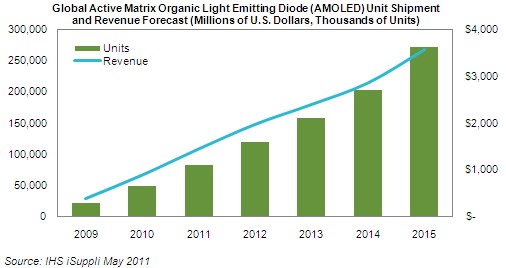

The bean counters at iSuppli are talking screens today, more specifically the AMOLED (active matrix organic light-emitting diode) type that Samsung uses in both generations of their Galaxy S Android powered smartphone, along with Nokia in their high end multimedia and enterprise devices. According to iSuppli there were 49.4 million AMOLED displays shipped in 2010 and that number is set to explode to 271.2 million displays shipped in the year 2015 alone. In terms of revenues, $892.1 million was made off AMOLED in 2010 and in 2015 that figure is expected to hit $3.6 billion. The winner here is of course Samsung, who has been investing billions into their AMOLED factories. There’s a new factory expected to open at the start of 2012 that will have the capacity to ship 8 million 4 inch screens per month. As for when we’re going to see AMOLED put to use in something other than smartphones, iSupplie predicts that mass production of tablet sized AMOLED panels isn’t likely to begin until 2013.
Not all is fun and games however. “While the benefits to AMOLEDs are clear, challenges still remain,” said Vinita Jakhanwal, Principal Analyst at iSuppli. “These challenges include high manufacturing cost, resolution challenges, limited product lifetime, reduced visibility in sunlight and a complex, time-consuming manufacturing process.” Compared to a display built using low-temperature polysilicon technology (LTPS) a comparable AMOLED unit can cost between 30% and 60% more to manufacture. It’s why the iPhone has yet to make the switch to AMOLED, despite their improved color reproduction, battery life, contrast ratio, refresh times, and thin form factor.
Considering the amount of time people spend staring at the small screen they carry with them everywhere, it’s important that their device has a high quality display. Consumers are going to start demanding that, so expect to see not only AMOLED taking off, but also more and more handsets shipping with an IPS enabled LCD like that seen in the iPhone 4.