By Dusan Belic on Tuesday, February 9th, 2010 at 4:41 AM PST
In Devices, FCC, Samsung

The first Bluetooth 3.0-enabled device, Samsung S8500, has been blessed with the FCC approval. It looks like a European version, so we wonder why the Korean company had to take this route, anyway.
Full specs are still a mystery, but we know few things – the S8500 will ship with a 3.1-inch AMOLED touchscreen, quad-band GSM radio, WiFi, Bluetooth, 1000 mAh battery and a microSD memory card slot. As soon as we hear something new, you’ll be the first to know. Stay tuned…
[Via: SamsungHub]
By Will Park on Thursday, February 4th, 2010 at 1:18 PM PST
In Announcements, FCC
If you live in a not-quite-dead zone but suffer from weak enough cellular signals to justify the use of a cell signal booster, you might be interested in what the FCC has to say about cell boosters. The Federal Communications Commission is mulling a possible ban/restriction on cellular network boosters that are used to amplify wireless cellular signal, and is looking for public comment on the possibility. At issue here is the CTIA’s (the wireless industry’s cheerleaders) concern that improperly designed cell boosters can interfere with wireless carriers’ cellular networks in some cases. To that end, the FCC is investigating whether or not some sort of restriction is necessary, and is seeking public comment on the matter.
The CTIA says that the use of signal boosters, which extend and amplify cellular signals, have the potential to harm wireless network performance. Interference from signal oscillation and cell-site overloads are apparently bad enough to reduce a cell tower’s capacity or take it down altogether. It’s a serious problem that deserves a serious investigation. But, does that mean all cell signal boosters be banned?
Well, according to the leading cell booster maker, Wilson Electronics, the FCC would do well to adopt new standards for approving and certifying cell boosters, rather than ban the devices altogether. Wilson says that “well-designed and -engineered signal boosters actually benefit not only wireless customers but the carriers as well” because no wireless network can push strong signals to every corner of the US and properly designed cell boosters help to fill in those gaps in coverage without detriment to wireless networks.
It’s not just about carriers preserving network integrity either. The point is that carriers can co-exist with cell boosters, as long as they are properly designed. According to Joe Banos, Wilson COO, “We strongly believe that raising the FCC certification approval standards for cell signal boosters would protect performance of cell towers and prevent service disruptions that can be caused by some unsophisticated cell phone signal boosters in service today.”
Wilson proposes that the FCC adopt standards that would require all signal boosters to meet the following certifications:
- effective self-oscillation (feedback) detection and automatic shutdown;
- effective cell tower proximity detection and automatic shutdown to prevent cell-site overloads; and
- bi-directional (tower-to-device and device-to-tower) signal amplification.
It seems that a few bad seeds in the cell booster game have sullied the image of more reputable booster-makers. Wilson Sales Director Walt Brooks recently told IntoMobile that many other cell boosters amplify only incoming signals, which often causes a cellphone to dial-down its outgoing radio transmissions, which in turn leads to degraded cellular performance. That hurts the consumer as much as the carrier. If you’d like to leave a comment, you have until Feb. 5.
Go here for the FCC’s public notice.
File your comment here.
By Will Park on Saturday, January 30th, 2010 at 11:14 AM PST
In AT&T, Android, Devices, FCC, HTC, Hottest Hardware, Nexus One, Rumors, T-Mobile

The Google (NSDQ: GOOG) Nexus One is already available on T-Mobile USA and will soon hit Verizon (NYSE: VZ)’s network as the gotta-have Android phone of the year, but AT&T (NYSE: T) has been conspicuously missing. That is, until today – an AT&T 3G-compatible version of the Nexus One has just popped up on the FCC’s website, hinting at the possibility that Google will soon release a new Nexus One variant capable of pulling down 3G data on AT&T’s wireless network. If true, the Nexus One will be available on three out of the four top US wireless carriers – Sprint (NYSE: S), it seems, is being left out of the party for now.
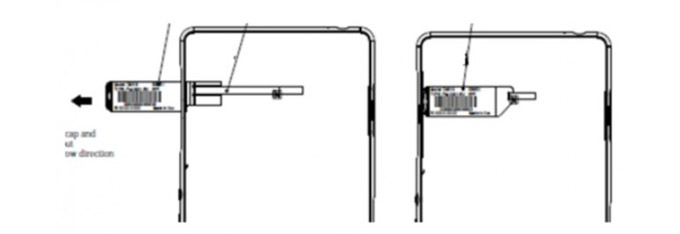
Engadget is reporting today that the FCC has unveiled a new identification label for an as-yet-unannounced Nexus One variant. The label you see on the right (above graphic) lists an ID number that corresponds to the current T-Mob-ified Nexus One. The label on the left sports an ID number that differs by a single digit, indicating that it’s a variant of the original. FCC doc also confirm that the new variant supports 3G on WCDMA Bands I, II, and V, making it compatible with 3G bands used by AT&T in the US. From the looks of it, the Nexus One is headed to AT&T!
Although Google has previously neglected to mention AT&T as a partner for their Nexus One, it makes sense to open up Google’s first own-branded Android phone to a wider market. Unless, that is, we’re looking at a label for the “Moogle” phone (Nexus Two).
[Engadget via: PhoneDog]
By Stefan Constantinescu on Friday, January 29th, 2010 at 9:35 AM PST
In FCC, Toshiba
The Toshiba (OTCPK: TOSBF) TG01 sure didn’t get a lot of love when it was announced. Toshiba just doesn’t have the same brand recognition that HTC or even Samsung have when it comes to Windows Mobile devices. Yes, it was the first device to ship with Qualcomm’s 1 GHz Snapdragon processor, but the operating system sitting on top of that power hardware was Windows Mobile 6.1. Yes, it did eventually receive and upgrade to 6.5, but the damage to the TG01’s reputation was already done when Toshiba’s public relations people showed off their “innovative” skin on top of Windows Mobile that was no where near as nice as HTC’s Sense UI or Sony Ericson’s Panels.
Enough poo pooing on the TG01, the TG02 is making its way through the FCC which means it will probably be announced next month at Mobile World Congress! No specifications to share with you, except that it’s a quadband device with 2100 MHz and 900 MHz HSPA, sorry North America. The leaked image below is the best/only leak we have so far:
[Via: Engadget]
By Dusan Belic on Thursday, January 28th, 2010 at 12:31 AM PST
In Cricket, Devices, FCC

Cricket will be adding a new low-end clamshell to its portfolio in the near future — or at least this Cal-Comp made phone (A150) found at the FCC suggests so. It’s a basic tri-band CDMA (850/1700/1900 MHz) device, which we guess comes with Bluetooth connectivity support and probably a microSD memory card slot. In other words, it’s one of those phones for folks who need it for basic talking and messaging. Accordingly, it is expected to be as cheap as $50 without any contract signed…
[Via: PhoneScoop]
By Will Park on Thursday, January 21st, 2010 at 3:58 PM PST
In Announcements, FCC, Verizon
There’s been a good deal of hubub surrounding Verizon (NYSE: VZ)’s decision to up their early termination fee (ETF) for “advanced devices” to a whopping $350. The increased ETF was met with consumer outrage that eventually led to the FCC issuing public statements about how it’s not cool to charge customers an ETF that is meant to help with sales commissions and store expenses. The good news is that all this talk about Verizon’s unfair ETF policy has apparently prompted the carrier to ease up on its ETF requirements. Verizon has removed 10 high-end feature phones from its “advanced devices” list, freeing those phones of the burden of an ETF that could cost more than the phones themselves.
We haven’t heard anything from the FCC, nor Verizon, on what prompted the shift in policy, but it’s a good bet that things were getting a little too hot for Verizon’s legal team. It’s got to be hard trying to justify a non-smartphone as an “advanced device” just because it has a touchscreen.
Whatever the reason, feature phone buyers going to Verizon Wireless will be happy to hear that their devices will only be tied down with the lesser $175 ETF.
Check out Verizon’s “advanced devices” list here.
[Via: Engadget]
By Simon Sage on Tuesday, January 19th, 2010 at 7:25 AM PST
In BlackBerry, FCC
That mysterious new BlackBerry (NSDQ: RIMM) 8910 that made it through Bluetooth certification last week has popped up again at the FCC. Conspicuously absent is any sign of 3G support – that’s right, quad-band EDGE just like it’s grandaddy 8900 Curve before it. This could, in fact, be the rumoured Atlas handset, and aimed at an Asian/European market initially, but it’s still too early to tell for sure where it will be launching. 3G seemed like the only thing that would have made an update worthwhile, but without it the 8910 may very well be little more than a facelift with a trackpad on the side. There’s the argument that EDGE is good enough for areas without supporting high-speed coverage, especially for a device primarily driven by e-mail, but “good enough” is far from competitive with other data-hungry smartphones out there. Who knows, maybe carriers wanted to cap how much subscribers tax their data network and pressured RIM to continue providing an EDGE-only handset. Whatever the case may be, the 8910 better be offering more than a trackpad and extra memory versus the 8900, if only to be worth the trouble of making it in the first place.
[via PhoneScoop]
By Dusan Belic on Wednesday, January 6th, 2010 at 1:05 AM PST
In Devices, FCC, Motorola

A new Moto slider iDEN phone appeared on the FCC pages – i890. It’s kinda ugly-ish, the way we got used to with most of iDEN phones, which because of their “ready for industry nature” are usually “designed” that way. The clamshell-shaped device comes with a 2-megapixel camera, Bluetooth connectivity support, music player, GPS, push-to-talk (of course), and a microSD expansion slot. No word on pricing or release date, though. We are sure, however, this baby is heading to Sprint (NYSE: S)/Nextel and possibly Boost as well…
[Via: PhoneScoop]
By Simon Sage on Tuesday, January 5th, 2010 at 2:14 PM PST
In Asus, FCC, GPS/Satellite Navigation, Rumors, T-Mobile
A fresh handset from asus has passed through the FCC, complete with 3G support on T-Mobile (NYSE: DT)’s 1700/2100 bands. asus’s main interest in mobile these days has been in conjunction with Garmin for their joint nüvifone brand. Odds are good that it will be running Android, but the lukewarm reception of the G60 on AT&T has us a little worried about future products in the family. The concept of a smartphone that excels in GPS services and navigation is a solid one, but depends entirely on the implementation. With any luck, we’ll hear more at CES starting tomorrow.
[via CellPhone Signal]
By Will Park on Wednesday, December 30th, 2009 at 1:47 PM PST
In AT&T, Announcements, FCC, Telecommunications
In a world where 1 out of every 5 US homes have shunned landline phones in favor of a wireless-only lifestyle, it’s clear that wireline phone service is dying a slow death. Every year, more and more Americans are opting to use their mobile phones as their only means of communications. AT&T (NYSE: T) apparently wants to hasten the death of the wireline telecom infrastructure that, for decades, was its core business. In a 32-page comment about their thoughts on an all-IP telephone network, AT&T asked the FCC to abolish regulations that require the telecom giant to support and maintain landline infrastructure. Taking things a step further, AT&T asks the FCC to set a deadline for completely phasing out wireline services.
While the increasing proportion of wireless-only homes might seem a compelling argument to abandon landline networks, there’s a flip side to the story. Something like 1 in 5 Americans still depend on the dial-tone box connected to the telephone jack in their home. Unfortunately, AT&T’s argument to adopt VoIP-only phone service throughout the US doesn’t make any provisions for Americans still tethered to a corded phone.
A short-term phase-out of wireline infrastructure might not be in the cards for AT&T, but you can’t blame them for trying. Landline infrastructure is significantly more expensive to maintain and has been generating less and less revenue over the years. The total number of landline phone calls dropped 42% between 2000 and 2008, leading to revenue declines of 27% from 2000 to 2007. And with their wireless infrastructure improvement costs soaring into the tens of billions of dollars, it makes sense that AT&T wants to move away from landlines.
Now, it’s up to the FCC to determine how to setup the nation’s transition to a VoIP-based telephone network. This should get interesting.
[Via: GigaOm]