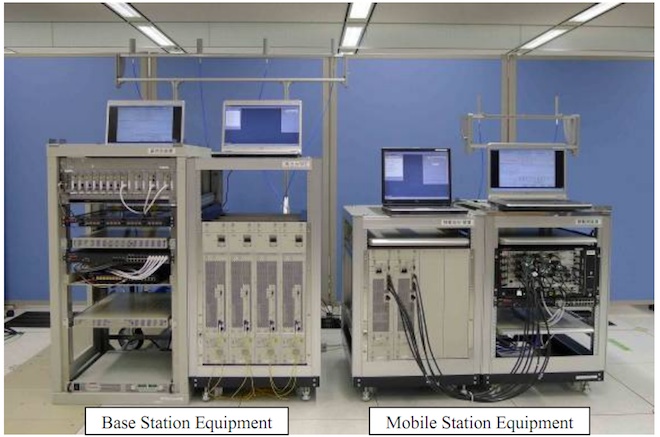

Japanese operator NTT DoCoMo have announced that they’ve received permission from the Kanto Bureau of Telecommunications and the Ministry of Internal Affairs and Communications to start testing LTE Advanced in a real world environment and will be doing so in the cities of Yokosuka and Sagamihara. They’ve already hit download speeds as high as 1 Gbps on the downlink and 200 Mbps on the uplink in the lab, and are eager to see what they get in the actual cities filled with buildings, people, cars, etc. Now I know what you’re thinking: wait a minute, hasn’t LTE just launched? True as that may be the mobile industry never stops evolving and LTE Advanced, along with WiMAX 2, were supposed to be the real “4G” wireless standards, that is until the International Telecommunications Union caved to pressure from American operators who wanted to label their HSPA+, LTE, and WiMAX networks as 4G, but small grudges aside, let’s actually define how LTE Advanced works.
Up until now a mobile device connected to a cellular network using a single antenna. Said antenna could handle connecting to blocks of frequencies, think of them as pipes, that were as wide as say 5 Mhz or even 10 MHz. With LTE Advanced, as well as with dual carrier HSPA+, devices now connect to multiple blocks, up to 5 of them in fact, each 20 MHz wide, on the downlink and up to 2 of them, again each 20 MHz, on the uplink. In other words for LTE Advanced to work operators are going to need huge blocks of spectrum, something that today they simply don’t have, but governments all around the world are looking to fix that. With LTE Advanced you could even replace the need for having a wire strung to every apartment unit and home for broadband since 1 Gbps can handle HD video, high speed internet, and a heck of a lot more.
Update: They’ve already started testing LTE Advanced in a real world environment in South Korea and hit 600 Mbps in a moving vehicle!
[Via: Phone Scoop]