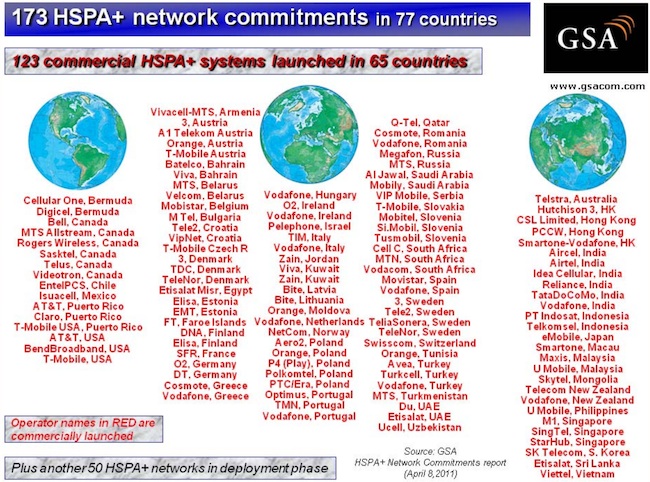

The GSA (Global mobile Suppliers Association) has published a series of documents (registration required; it’s free!) detailing the HSPA and HSPA+ networks that are either deployed or are in the process of being deployed around the world, and the numbers are truly stagering. There are nearly 400 HSPA networks that are fully operational, 123 of which use the higher speed flavored HSPA+. Of those 123, 90 do 21 Mbps, 10 do 28 Mbps, and 23 are rocking out at a mind numbing 42 Mbps with 36 additional operators promising to reach that speed at some point in the future. No one has yet to launch an 84 Mbps HSPA+ network, so the race is on to see who has the money to burn to buy new networking gear, but also who will be the first to build consumer products that are even capable of going that fast.
It’s not that we don’t love LTE at IntoMobile. The technology has certainly showed some impressive results, both in Europe, where TeliaSonera is giving customers an average download speed that surpasses 40 megabits per second, and in America, where Verizon’s network has gained mass appeal among road warriors who say that in most cases they get a faster connection with the Big Red than they do at home. The thing with LTE though is that it’s a costly upgrade for operators wanting to roll it out and the ecosystem of devices that can take advantage of it is minuscule. With HSPA+ we’ll see multiple 21 Mbps capable handsets be released this year, the first of which was the T-Mobile Vibrant 4G, and it shouldn’t be too long until we have 42 Mbps smartphones. With HSPA+ there’s no need to fiddle with untested voice protocols, VoLTE (Voice over LTE), because HSPA+ is just a faster form of 3G, whereas LTE is a data only technology that needs to have traditional “legacy” services bolted on top.
[Via: Cellular News]