
Batteries are the necessary evil for our love affair with our mobile toys. Unfortunately, batteries aren’t very environmentally friendly, which is why you should send them off for proper disposal instead of just tossing them in your trash can. Moreover, even the best little lithium-ion batteries today don’t last for as long as we’d like them to, which is typically just a few hours before needing a recharge. A new discovery with electron switching could make organic batteries, theoretically environmentally friendly and longer lasting, a possibility.
Gizmag reports:
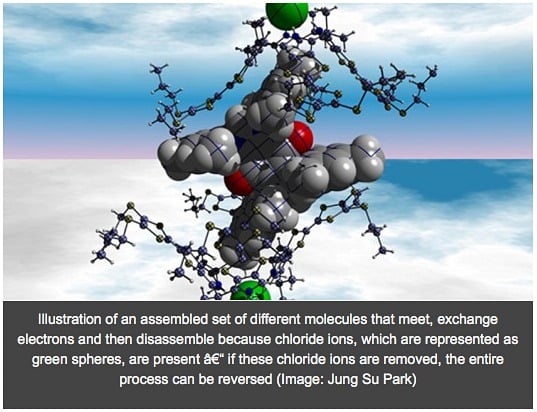
Batteries consist of electrochemical cells that store energy in the form of chemical energy, which is converted into electrical energy when connected to an electrical circuit in which an electrical current can flow. When molecules meet, they often form new compounds by exchanging electrons. In some cases, the electron transfer process creates one molecule with a positive charge and one molecule with a negative charge. Molecules with opposite charges are attracted to each other and can combine to form something new.
And University of Texas at Austin chemists Christopher Bielawski and Jonathan Sessler have been able to create molecules that don’t meet to form new compounds:
“These molecules were effectively spring-loaded to push apart after interacting with each other,” says Bielawski, professor of chemistry. “After electron transfer occurs, two positively charged molecules are formed which are repelled by each other, much like magnets held in a certain way will repel each other. We also installed a chemical switch that allowed the electron transfer process to proceed in the opposite direction.”
How is the ability to exchange electrons without forming new compounds important in building organic batteries? Biewlawski says that “understanding the electron transfer processes in these molecules provides a way to design organic materials for storing electrical energy that could then be retrieved for later use.”
The two chemists also say that organic batteries have the potential of lasting much longer than the batteries we use today. While the batteries we use now often contain toxic heavy metals, the longer-lasting organic batteries would theoretically be harmless to the environment. Additionally, the potential to be thinner and lighter is there along with the ability to retain a charge for a week or even up to a month.
Imagine if you could just carry your iPhone or EVO around for several days at a time without having to worry about finding an electrical outlet.
[Via: Gizmag]