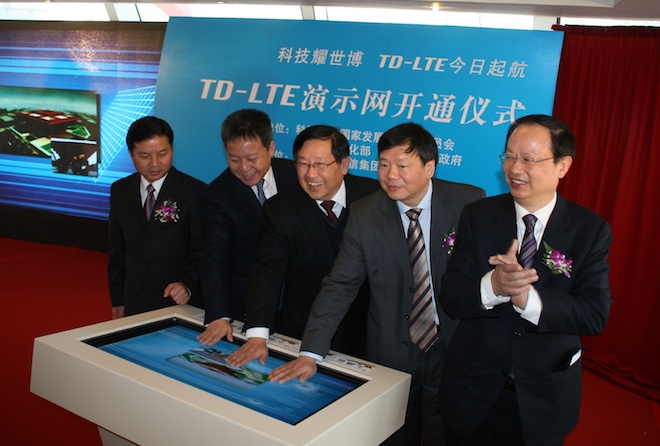

China Mobile, the largest operator in the world based on number on subscribers, something to the tune of 584 million people as of December of last year, has said that they’re planning to test TD-LTE in the cities of Shanghai, Hangzhou, Nanjing, Guangzhou, Shenzhen, Xiamen and Beijing over the course of this year. They hope to achieve download speeds of around 100 Mbps and to turn on a commercial network at some point in 2012. The first type of products to support such ludicrous speeds are going to be USB modems, and it may be a while until you see a TD-LTE phone. There’s a rumor floating around that the 6th generation iPhone, the one that’s going to come out in the summer of 2012, will support TD-LTE technology, but it’s way too early to speculate on that. The rumor mill for the iPhone 5 hasn’t even begun to spin at full tilt, so let’s just be patient when it comes to discussing the successor.
Now what exactly is TD-LTE and how does it differ from what’s being offered by the likes of Verizon in the USA? TD-LTE uses one radio channel to both transmit and receive data, whereas FD-LTE has a dedicated upload and download channel; the latter is otherwise known as paired spectrum. Time Division (TD) LTE was developed by China Mobile, is cheaper to roll out, and more importantly it’s so similar to Frequency Division (FD) LTE that handset makers can support both technologies using the same chipset. Most operators however are going to use FD-LTE because it offers a direct upgrade path to their current 3G networks; they already own paired spectrum. TD-LTE is more for data than anything else, and the fact that it’s a Chinese standard has some people a little bit miffed.
All we know is that high download speeds for mobile users are coming and regardless of the technology we’re all going to be downloading movies at close to 100 Mbps by the time this decade comes to a close.