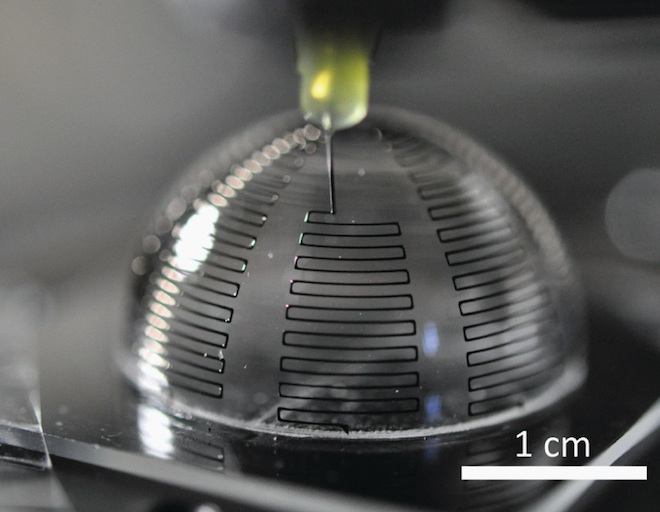

Grab a device like Nokia’s N8 and try to count the number of antennas there are inside. You’ve got 4 just for GSM/EDGE, 5 for 3G, 1 for Bluetooth, 1 for WiFi, and 1 for the FM radio. That’s a total of 12, and that number is only going to go up as innovations such as Long Term Evolution (LTE) and near field communication (NFC) start making their way into future flagship devices. How exactly is one supposed to fit all that metal inside a mobile phone and ensure that they’ll get a strong signal? Researchers at the University of Illinois have come up with a solution and it’s so futuristic that we’re wondering if their mad science will ever land inside a product. First they make a round bubble out of glass, replacing the traditional flat antennas of yore, then they take ink with silver nanoparticles inside and draw a pattern on said bubble using a 3D printer. Wait for everything to dry, and boom, you’ve got something that “approaches the fundamental limit dictated by physics (known as the Chu limit).” They’ve basically made the perfect antenna, but now they have to deal with finding a way to produce these things at scale, getting the cost down, and making them small enough to fit inside a mobile phone.
So now the question is when? They don’t provide any timelines, and that honestly lets us down. We cover a lot of articles published by research instituions, and while we get excited after finishing someone’s research paper, it doesn’t take long for the inevitable letdown to take place when it hits us that this stuff really is science fiction. Take all this new “revolutionary battery technology that allows for an instant full charge and can withstand thousands of charge cycles”, that’s been in the news longer than this site has been up.
[Via: Engadget]