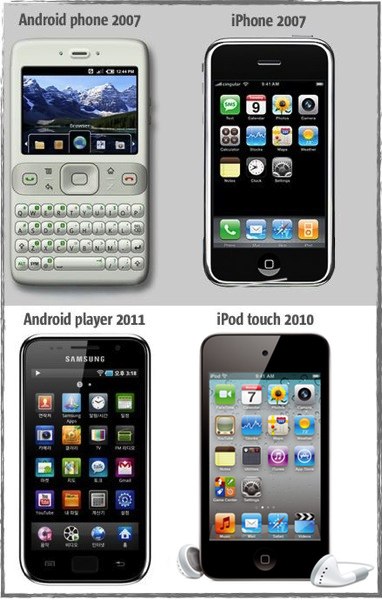
Imagine being stuck in a room watching re-runs of terrible reality shows, or a collection of some the worst movies ever made. Well, that’s what this patent war feels like: nauseating. Apple, in a message to the ITC claims it inspired Andy Rubin to make Android (yes, you heard right). This claim could have major legal implications for a future Apple lawsuit against Google or possibly even for Apple’s dispute with Google’s recent $12.5 billion acquisition of Motorola.
Andy Rubin worked at Apple long before the days of the iPhone and iPod. Apple mentions in the filing to the ITC that it has a legal obligation to make truthful representations of fact (in its own eyes) and that Rubin’s superiors at Apple were the inventors of the realtime API patent and he worked for them at the very time they made that invention. Basically, Apple is discrediting Andy Rubin for his part in the development and implementation of the new realtime API invention, because he wasn’t a senior engineer. Sounds ridiculous, right?
Here’s a quote from Apple’s recent reply, obtained by FOSS Patents, which shows a brief to the ITC staff’s and HTC’s petitions for review of the Administrative Law Judge’s (ALJ) initial determination that found HTC to infringe two patents, including the ‘263 “realtime API” patent:
Android and Mr. Rubin’s relevant background does not start, as HTC would like the Commission to believe, with his work at General Magic or Danger in the mid-1990s. In reality, as the evidence revealed at the hearing, Mr. Rubin began his career at Apple in the early 1990s and worked as a low-level engineer specifically reporting to the inventors of the ‘263 [realtime API] patent at the exact time their invention was being conceived and developed. […] It is thus no wonder that the infringing Android platform used the claimed subsystem approach of the ‘263 patent that allows for flexibility of design and enables the platform to be “highly customizable and expandable” as HTC touts. […] While Mr. Rubin’s inspiration for the Android framework may not be directly relevant to the pending petitions for review, that HTC felt compelled to distort this history is illustrative of the liberties it takes in attacking the ALJ’s [initial determination] and the substantial evidence supporting the ALJ’s findings.
As FOSS Patents points out, look at the first two sentences again: “Android […] does not start […] at General Magic or Danger.” According to this filing, it all started at Apple. Is this fact, or delusions of grandeur? If Apple gets its way and the ITC upholds the initial determination that the ‘263 patent is valid and infringed by Android, Google should be worried. I happen to be one of those people that finds this not only counter-productive, but a roadblock that stands in the way of innovation. What about you?