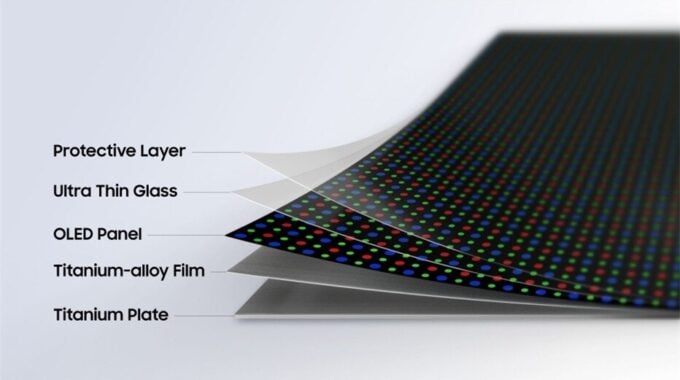
Samsung has announced a new display technology called Flex Titanium, designed to make its next-generation foldable phones more durable and easier on the eyes. The key selling point: less visible crease and a slimmer profile, without sacrificing the ability to survive daily wear and tear.
The technology is built around two titanium-based components that work together inside the display stack. Samsung says the approach is the result of seven generations of foldable engineering, combined with feedback from real users who have made clear what they want from foldable phones: a bigger, more immersive screen that does not look obviously folded and does not break after a year of use.
This is a significant moment for the foldable category, which has struggled to shake the perception that the crease down the middle of the screen is a dealbreaker. Every major foldable maker has tried to minimize it, with mixed results. Samsung is now betting that titanium, used in aerospace applications like satellite antennas and Mars rover wheels, is the right material to finally move the needle.
The first component is a titanium-alloy film that sits below the OLED panel inside the display. Samsung says it is about one-third the thickness of a human hair and offers 20 times the mechanical stiffness of standard polymer film. That combination, thin but stiff, allows the display panel itself to be slimmer while staying structurally sound.
Below that sits a titanium plate, which supports the display module from underneath. Samsung used a micro-patterning process to add tiny holes to the section of the plate that bends during folding. This gives that area enough flexibility to fold repeatedly without cracking, while the rest of the plate stays rigid enough to support the screen when it is open flat. The plate also bonds more tightly to the display module by eliminating air gaps through a process Samsung calls advanced hole processing technology.
The result, according to Samsung, is a display that:
- Shows a less visible crease when unfolded
- Maintains a slimmer overall device profile
- Handles external shocks better than previous designs
- Holds up to repeated folding over time
Samsung has also updated the display’s internal architecture with high-resolution components and new organic materials that reduce power consumption. The company says this adds up to a meaningful boost in power efficiency, though specific numbers have not been shared yet.
Titanium is not new to smartphones. Apple used it for the frame of the iPhone 15 Pro. But applying it inside a foldable display stack, where the material needs to be both paper-thin and flexible enough to fold thousands of times, is a different engineering problem entirely. Samsung’s solution to make it work involves precision rolling to get the alloy film thin enough, and micro-patterned holes to give the plate the flexibility it needs without weakening it.
Kyung-Jin Yoo, EVP and Head of Mobile Display Product Development at Samsung Display, said the micro-patterned holes in the folding section of the titanium plate were key to getting durability and flexibility to coexist. Sunghoon Moon, EVP at Samsung Electronics’ Mobile R&D Office, framed the technology as the product of years of listening to what foldable users actually want in everyday use.
Flex Titanium will debut in Samsung’s next-generation Galaxy foldable devices, with full details expected at Galaxy Unpacked, scheduled for later in July 2026. The event is already generating attention after Samsung teased it with an invitation themed around a “new shape” unfolding, suggesting the design changes go beyond just the display materials.
For the foldable market to grow beyond its current niche, manufacturers need to close the gap between foldables and traditional flat smartphones on durability and screen quality. If Flex Titanium delivers what Samsung is promising, it could give the Galaxy Z Fold line a meaningful edge at a time when competition from Chinese brands like Huawei and Honor is intensifying.