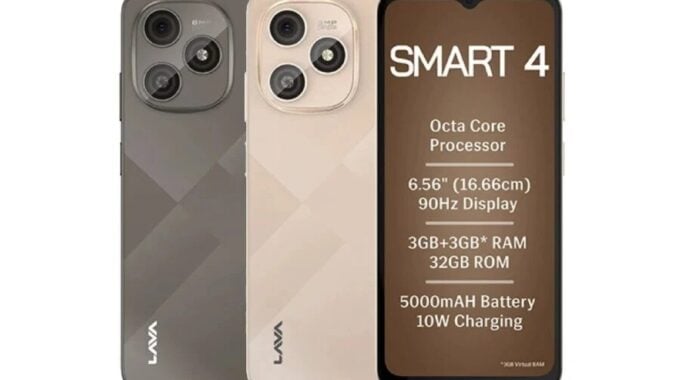
Military-grade durability certification on a phone that costs less than Rs. 9,000. That’s the pitch with the Lava Smart 4, and honestly, it’s a smarter angle than just slapping a big battery number on the box and calling it a day. Lava has launched this new entry-level device in India, targeting budget shoppers who want something that won’t fall apart after a few months of real-world use.
The Smart 4 runs Android Go, which makes sense at this price point. Android Go is a lighter version of Android designed for phones with modest specs, and it keeps things running smoothly on hardware that would otherwise struggle with a full version of the OS. Lava is pairing it with a Unisoc chip, the same one it used on the Yuva Star, so this isn’t exactly unknown territory for the brand. Storage is on the tighter side, but the phone supports microSD expansion up to 512GB, so you’re not stuck with what’s in the box.
What makes the Smart 4 stand out for its price category is the feature list that usually shows up on phones costing more. The MIL-STD-810H certification means it’s been tested against things like drops, dust, humidity, and temperature extremes. That’s a real spec, not just marketing fluff. Budget phones in India take a beating, and this certification actually means something to someone buying their first or second smartphone.
Beyond the durability angle, the rest of the hardware is practical rather than flashy:
- Side-mounted fingerprint scanner
- 3.5mm headphone jack
- FM radio
- Dual 4G VoLTE support
- Wi-Fi and Bluetooth 4.2
- GPS
- USB Type-C port
The 3.5mm jack is still a big deal for this market. A huge chunk of budget phone buyers in India use wired earphones daily, and brands that drop the headphone jack at this price tier tend to hear about it. FM radio is also genuinely useful in areas with spotty data connectivity. These are not exciting specs to write about, but they’re the right specs for the audience Lava is targeting.
The Smart 4 is priced at Rs. 8,499 and comes in two colors, Konark Gold and Ajanta Grey. It’s available through Lava’s offline retail outlets and service provider networks, with financing options available if you’d rather spread out the cost. Keeping it offline-first is a deliberate move. Lava has a strong retail presence across India’s smaller cities and towns, and that’s exactly where phones like this sell best.
The broader story here is that the sub-Rs. 10,000 segment in India is more competitive than ever. Brands are fighting hard for first-time smartphone buyers and feature phone upgraders. Lava’s strategy is to lean into practical features, local trust, and offline availability rather than spec-sheet one-upmanship. So far, that approach is holding up. The Smart 4 won’t win any performance benchmarks, but it doesn’t need to. It just needs to work reliably for the people buying it, and from the looks of it, Lava has thought that through.