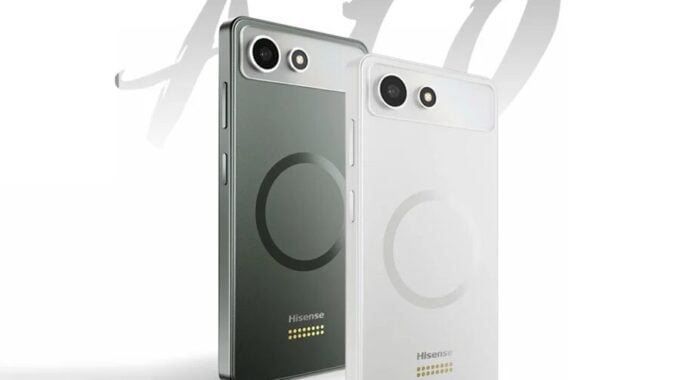
Most e-ink phones ask you to make a hard choice: great battery life and eye comfort, or actually being able to use your phone like a normal person. Hisense thinks it has found a way around that problem, and honestly, the solution is more clever than I expected. The company launched the A10 series on August 28, 2026, with two models, the A10 Pro and A10 Ultra, starting at 2,799 yuan.
An e-ink screen that’s actually built for real use
Both phones carry a 6.13-inch Carta 1300 e-ink display running at 1648 x 824 pixels with a pixel density of 300 PPI. That’s sharp enough to read text comfortably, and the panel supports 256 levels of grayscale plus 36 levels of dual-color front lighting. So you can adjust it in a dark room without frying your eyes.
Because it’s e-ink, the screen uses reflected ambient light instead of blasting light directly at you. No blue light, no flicker. Hisense has clearly aimed this at readers, students, and anyone who annotates PDFs for hours at a time. And to help things stay smooth, the A10 pairs the display with an E Ink T2000 hardware TCON chip, which handles screen refresh on its own, cuts down on ghosting, and takes load off the main processor. That’s a smart move, not just a spec sheet bullet point.
The detachable color screen is the real story here
Here’s where things get interesting. The A10 has an optional 4.96-inch LCD panel that magnetically clips onto the back of the phone using a magnetic ring and metal contacts. You snap it on when you need color, and pull it off when you don’t. Want to scroll through Instagram or watch a short video? Attach it. Want to read for two hours without wrecking your eyes? Take it off.
The A10 Ultra ships with the magnetic color screen included in the box. The A10 Pro has the magnetic contacts built in but doesn’t include the secondary screen, so you’d need to buy it separately. It’s a bit of a bummer that the cheaper model doesn’t come ready to go, but at least the option is there.
This modular approach is genuinely interesting because it lets the phone work as a proper e-reader without compromise, while still giving you a path to full color when you need it. That’s a better answer than most e-ink phones have come up with.
The specs holding it all together
Under the hood, both models run on Qualcomm’s QCM6690 octa-core chip built on a 4nm process, with 5G support. The processor is tuned for e-ink use, meaning it can throttle down during static reading to save power, then ramp back up when you need it. The phones run Android 16 out of the box and support long-term updates and security patches, which is more than a lot of niche devices promise.
You also get full access to the Android app ecosystem, which isn’t always a given with e-ink devices. Some manufacturers lock things down. Hisense doesn’t here.
The camera setup is a 48MP main shooter on the back and an 8MP front camera. Neither number is going to blow anyone away, but this phone isn’t trying to be a camera phone. Other features include:
- NFC
- Infrared remote control
- Wi-Fi 6
- Call recording
- App cloning
Why this phone matters beyond the niche
E-ink phones have always had a ceiling on their appeal because giving up color felt like too big a trade-off for most people. The A10’s modular screen doesn’t fully erase that trade-off, but it shrinks it significantly. And as screen time fatigue becomes a more common concern, a phone that defaults to a paper-like display starts to look less like a niche product and more like a practical choice.
Pricing starts at 2,799 yuan, which converts to roughly $385 USD. For what you’re getting, that’s competitive. Whether this reaches global markets is still unclear, but if it does, Hisense might have something genuinely worth your attention here.