Samsung is taking a page out of Apple’s playbook, and honestly, it might actually work this time. A leaked die shot of the Exynos 2700, Samsung’s next in-house flagship chip, has surfaced months before any official word. And the details are genuinely interesting.
According to SamMobile, the Exynos 2700 is set to debut inside the Galaxy S27 and Galaxy S27+ in early 2027. The die shot, published by SemiAnalysis, gives us a surprisingly clear picture of what Samsung has been building.
Start with the CPU. The Exynos 2700 has 10 cores total, but the configuration is unusual. There are two Arm C2 Ultra prime cores running at 4.24 GHz and 3.36 GHz, plus eight C2 Pro cores split between 3.74 GHz and 2.88 GHz. What’s missing? Efficiency cores. Gone entirely. That’s a bold call, and it’s exactly how Apple structures its A-series chips. Samsung is clearly going after raw performance here, not just ticking boxes.
The cache situation is also worth paying attention to. The chip carries a 24MB system-level cache that sits between the CPU, GPU, NPU, and main memory to speed up data sharing. Add in four 4MB L3 cache banks for the CPU, and you get a combined 40MB total. That’s more than MediaTek’s Dimensity 9500 and Qualcomm’s Snapdragon 8 Elite Gen 5. Apple’s A19 Pro still leads at 54MB, but Samsung is clearly closing the gap.
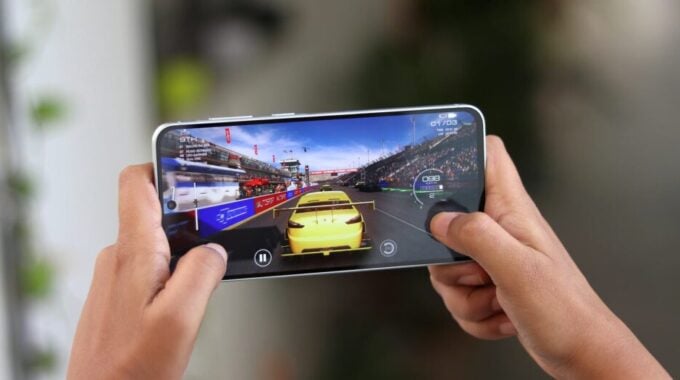
The GPU is where things get exciting. The Xclipse 970 takes up a big chunk of the die and is built on AMD’s RDNA 5 architecture, which hasn’t even officially launched on desktop yet. It has 16 compute units total, and early indications suggest it could be one of the most powerful mobile GPUs around. If the AMD partnership finally delivers here, after years of mixed results, that’s a real story.
The chip also supports LPDDR6 memory, an upgrade over the LPDDR5X RAM in current Galaxy flagships. There’s no integrated modem, so Samsung will rely on an external 5G chip, same approach as the Exynos 2600.
Rumors suggest the Exynos 2700 will outperform Qualcomm’s Snapdragon 8 Elite Gen 6 in both CPU and GPU workloads. Bold claim. But the specs shown here are not a bluff. Real benchmarks will tell the full story, but right now, Samsung’s chip ambitions look more credible than they have in years.