Forget just faster downloads. Samsung and Verizon just ran a trial that shows what 6G networks might actually do differently, and it’s more interesting than another speed record.
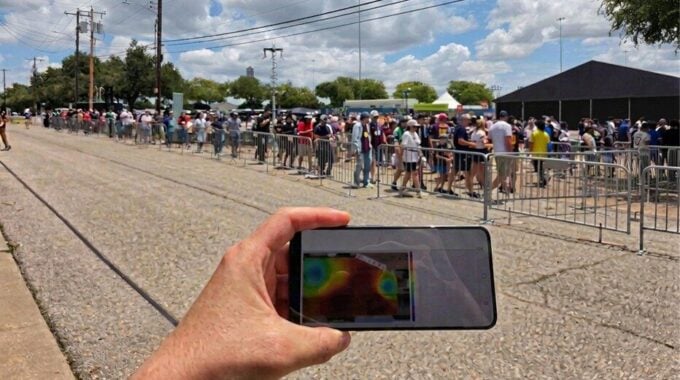
The two companies announced they completed a successful Integrated Sensing and Communication (ISAC) trial at a major international soccer fan event in Dallas, Texas. ISAC is a 6G concept where the network doesn’t just carry data, it also acts as a sensor, using wireless signals to detect what’s physically happening around it. In this case, that meant generating a real-time crowd density heatmap across a live venue, with no extra hardware beyond what’s already in a 5G setup.
Samsung’s Network in a Server platform combined commercial vRAN software with an ISAC application, and a CBRS radio unit mounted on a Verizon Cell-On-Wheels did the sensing. The system picked up channel variations from a standard 5G device and turned that into crowd movement data. No cameras, no tracking individuals, just signal patterns analyzed by AI on the edge.
So why does this matter? Most 6G coverage focuses on speed or latency. But ISAC is one of the more practical ideas in the 6G roadmap, with real uses across:
- Event management, spotting crowded food stalls or entrances before they become bottlenecks
- Security teams getting early warnings about dangerous crowd buildup
- Venue operators optimizing staff deployment in near real-time
And because Verizon already runs one of the world’s largest commercial vRAN networks, Samsung could plug ISAC in without rebuilding anything. That’s the actual story here. 6G features don’t have to wait for 6G networks if the software foundation is already in place.