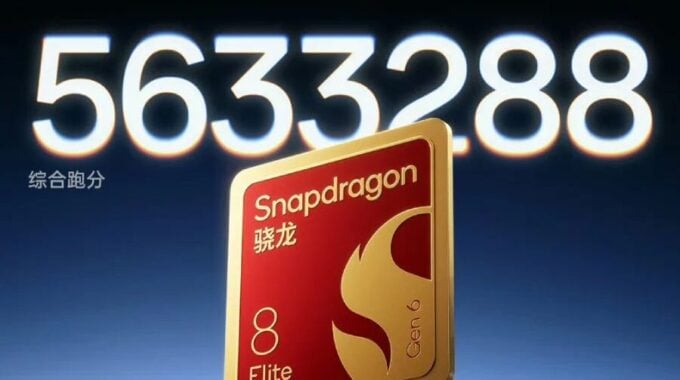
Leaked benchmark scores are almost always conservative. Companies run their own tests under tighter conditions, and the numbers come out higher. That’s exactly what happened with the OnePlus 16. According to Gizmochina, OnePlus has now shared its official AnTuTu result for the OnePlus 16, and it clears 5.63 million points. That’s a notable jump from the 5.38 million score that leaked just last week.
Yes, official scores from manufacturers come from controlled testing environments. OnePlus isn’t hiding that. But 5.63 million is still a big number, and the company is claiming this is the highest AnTuTu score of any phone running the same chip. That’s a flex worth paying attention to.
The chip in question is the Snapdragon 8 Elite Extreme Gen 6, built on TSMC’s 2nm process. This is one of the first phones to carry it, which already puts the OnePlus 16 in a small group. The processor uses an all-big-core CPU design with clock speeds above 5.0GHz. OnePlus is reporting a 13% bump in CPU performance over the previous generation and a 44% improvement in GPU performance. Those are serious generational gains, not marginal tweaks.
Gaming is clearly the angle OnePlus is pushing hard. The company worked with Qualcomm to build a gaming kernel called Wind Chaser, which sits at a lower software layer to give supported games access to a native 185FPS while holding that frame rate steady through longer sessions. PUBG Mobile is one of the confirmed titles. Getting to 185FPS is impressive on paper, but the real test is whether it stays there when thermals build up. That’s where most phones fall apart.
Beyond the chip, OnePlus built three of its own processors into the phone to support the gaming experience.
- P4 Super Display Chip: handles image rendering on the display side
- T3 Touch Chip: manages touch response speed and accuracy
- G3 e-sports network chip: targets network latency for online play
The idea is that every part of the chain, from your finger touching the screen to the image appearing in front of you, has dedicated hardware behind it. Whether that translates to a real difference in actual gameplay or just looks good in a spec sheet is something we’ll need to test properly.
On the display side, the OnePlus 16 is expected to come with a 6.78-inch 1.5K OLED panel from BOE, running at 185Hz. The screen is flat with large rounded corners and thin 1.15mm bezels on all four sides. That refresh rate matching the frame rate target is intentional, and it makes sense as a package.
Pricing and charging specs haven’t been shared yet. Both are expected at the October 12 launch event. So we’re getting plenty of performance detail before any of the practical buying information. That’s a familiar marketing approach, and it works to build hype. But until we know what this phone costs, the benchmark numbers only tell part of the story.
Still, a score above 5.63 million is the kind of number that gets people talking, and OnePlus clearly knows that. The October 12 event is shaping up to be a big one.