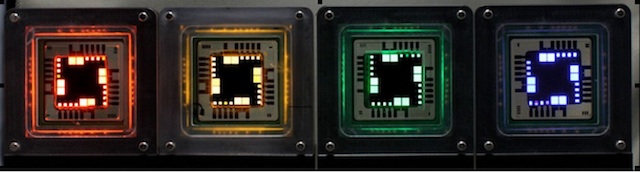

Millions of man hours worth of research had to be conducted in order to enable the technology that makes that brilliant screen on your mobile phone. From the dot matrix display on the first brick sized cell phones to the Super AMOLED Plus screen that makes the upcoming Samsung Galaxy S II absolutely gorgeous to look at, the pace of innovation hasn’t slowed down. Researchers at Samsung have announced that they’ve made the first full color display that uses quantum dot technology. Unlike LCDs, which are costly to make, and AMOLED, which has a limited lifespan and is difficult to stretch to sizes needed to go into devices like televisions and laptops, quantum dots promise to cost 50% less to manufacture than the omnipresent LCD technology of today while also surpassing the brightness levels of top of the line AMOLED screens.
The prototype Samsung demonstrated measured 4 inches across the diagonal, think Nexus S sized, and was also flexible. To make it Samsung makes a thin layer of quantum dots that they then carefully peel off before finally stamping it onto an array of thin film transistors made out of hafnium-indium-zinc oxide. The prototype has subpixels, meaning the red, green, and blue dots that make up an actual pixel, that measure 50 micrometers wide and 100 micrometers long. That’s small enough to go inside a mobile phone.
There is a catch to all this. The technology is at least 3 years away from hitting the market and right now prototypes begin to lose brightness after just 10,000 hours of use. That’s not to say Samsung is going to stop working on perfecting what they’ve achieved thus far. They’re a leader in display technology and supply many companies, including Apple, with their displays.
One more thing: LG announced, back in November 2010, that they’re teaming up with QD Vision to research quantum dot displays. The more players working at solving this problem, the faster it’ll come to market.