Toshiba copies Fujitsu RakuRaku handset, gets sued by Fujitsu
Posted by Will on Tuesday, March 18th, 2008 at 1:38 pm under Softbank, Financial, Fujitsu, Toshiba, DoCoMo, Announcements
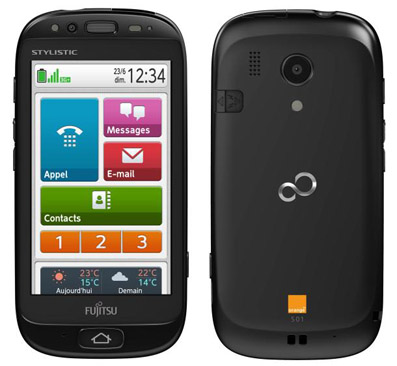
You mean companies can sue for copyright infringement on the design of a particular handset? That must have been news to Toshiba, seeing as how they blatantly copied a RakuRaku handset made by Fujitsu. You see, the Toshiba Kandan Keitai 821T is an almost carbon-copy of the Fujitsu Foma RakuRaku Phone III, prompting NTT DoCoMo and Fujitsu to get their lawsuit-on with Toshiba in the cross-hairs.
The suit states that Fujitsu has been designing the RakuRaku phones for senior citizens and that Toshiba has copied the RakuRaku Phone III's button layout and interface, with a body that bears a striking resemblance to the original. DoCoMo apparently warned Softbank prior to the launch of the Tosh 821T, but Softbank decided to launch the 821T as a handset for the "junior population." DoCoMo is seeking to have Softbank Mobile pull the Toshiba 821T off the market.
Something tells us that NTT DoCoMo and Fujitsu has a pretty strong case on their hands. This isn't China…
[Via: GearFuse]
If you found this story interesting, why not subscribe to our RSS feed to get your daily fix of mobile technology news?


In an era of ever diminishing handset footprints, there are undoubtedly some people feeling a bit left out in the cold. Namely, those people looking for an easy-to-use, easy-to-read mobile phone. 
NTT DoCoMo today launched the Fujitsu-made FOMA F904i, powered by Symbian OS with MOAP running on top of it. The new clamshell device allows users to enjoy the one-seg mobile TV on the 3.1" rotatable 16:9 240×432 full wide screen. There's also the 0.65" 96×30 external screen, two cameras - VGA for video calls and 3.2 MP for taking photos and videos, as well as the microSD expansion slot. The FOMA F904i measures at 108×50x22 mm, and weighs 138 g.
WiMAX looks to be emerging as the wireless broadband protocol of choice in the US and abroad. If only there were some way to fix the ridiculous power drain imposed by the WiMAX transmitter. Oh wait! There is a way! Fujitsu Laboratories Ltd. developed a technology to kick WiMAX transission amplifier efficiency into high gear! With 70% of total power going to the transmission amplifier, it makes sense to make it as efficient as possible.