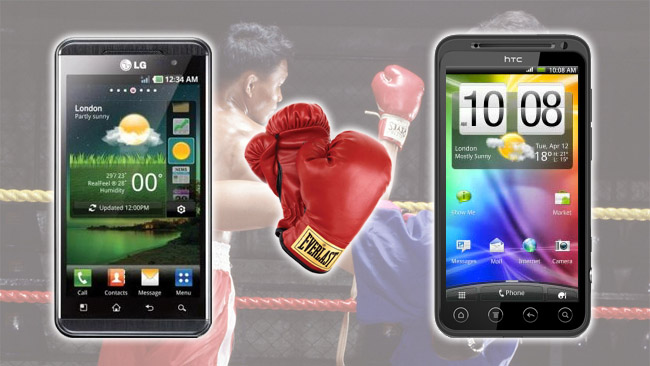
In our last “dilemma post,” we compared two of the best Android smartphones, both rocking dual-core processors. Today our focus is on 3D smartphones and in that sense we’ll be comparing the LG Optimus 3D and HTC Evo 3D. I’ll look at the European version of HTC’s phone to get a better perspective of the radio used (to be able to compare them). The one sold in the U.S. works on Sprint’s CDMA and WiMAX networks but other than that – it’s the same phone.
Like that was the case with our previous comparison, you won’t miss a lot by buying either the Optimus 3D or Evo 3D. Both are powerful phones and both will deliver an awesome experience. LG’s baby was the first Android smartphone with 3D screen and the rest of the world had to wait for some time to get the alternative — not sure why HTC hasn’t launched a GSM-based version of Evo 3D before. Anyway, here’s how two devices compare.
 LG Optimus 3D |
 HTC Evo 3D |
|
| Connectivity | GSM 850/900/1800/1900 HSPA 900/1900/2100 (or 850/1700/2100) HSDPA 14.4 Mbps, HSUPA 5.76 Mbps Wi-Fi 802.11 b/g/n, DLNA, Wi-Fi hotspot |
GSM 850/900/1800/1900 MHz HSPA 900/1700/2100 HSDPA 14.4 Mbps, HSUPA 5.76 Mbps Wi-Fi 802.11 b/g/n, DLNA, Wi-Fi hotspot |
| Screen | 4.3-inch WVGA (480×800) | 4.3-inch qHD (540×960) |
| Cameras | dual 5-megapixel, auto-focus, LED flash front-facing camera |
dual 5-megapixel, auto-focus, dual-LED flash front-facing camera |
| Memory | 512 MB RAM 8 GB storage microSD slot |
1 GB RAM 1 GB storage microSD slot |
| CPU | Dual-core 1 GHz, TI OMAP4430 PowerVR SGX540 GPU |
Dual-core 1.2 GHz, Qualcomm MSM8660 Adreno 220 GPU |
| Battery | Li-Ion 1500 mAh | Li-Ion 1730 mAh |
| Size | 128.8 x 68 x 11.9 mm 168 grams |
126 x 65 x 12.1 mm 170 grams |
You could easily see that HTC’s smartphone is a newer device – it has a faster processor and more RAM. Obviously it is a better choice of the two, but as I said – that doesn’t mean the Optimus 3D is a bad device, quite the contrary…