NTT Docomo shut down its i-Mode mobile service on March 31, 2026, marking the end of a 27-year run that fundamentally changed how people communicate digitally. The service launched in February 1999 and became the first to bring internet access to mobile phones on a mass scale.
While i-Mode never achieved global dominance and was eventually overtaken by smartphones, its most important contribution lives on in every text message, social media post, and email sent today: the emoji. Those small pictographs that help convey emotion and meaning across language barriers trace their origins directly back to Docomo’s mobile service.
Before smartphones existed, i-Mode broke new ground by making internet access possible on regular mobile phones. The service succeeded where others failed because of strategic decisions by Natsuno Takeshi, who led the launch and now heads Kadokawa Corporation. Instead of using the complex WAP markup language that other mobile services required, Natsuno chose c-HTML, a simplified version of standard web HTML that made it easy for existing website developers to create mobile content.
This decision proved crucial in building a robust content ecosystem quickly. Major Japanese banks joined the platform from the start, allowing users to check account balances and transfer money using their phones. Docomo’s television advertisements featuring popular idol Hirosue Ryoko highlighted this banking capability, positioning phones as essential daily tools rather than just communication devices.
The service later integrated FeliCa contactless technology, enabling phones to function as transit cards and electronic wallets. This “Osaifu-Keitai” (wallet cellphone) feature let users pass through train turnstiles and pay at stores by simply holding their phone over a reader.
i-Mode created Japan’s first significant digital content market, offering games, ringtones, and digital comics for around 300 yen each – roughly the price of an inexpensive magazine. The billing system made purchases frictionless by adding charges to monthly phone bills rather than requiring credit card information. Users only needed to enter a four-digit PIN to buy content.
This payment method proved highly effective because unpaid phone bills meant losing access to calls, email, and internet service – a major disruption to daily life that ensured high payment rates. Docomo took just 9% of content revenue, significantly less than the 25-30% fees charged by today’s Apple and Google app stores.
The service reached 5 million subscribers within its first year and expanded to 18 international markets including Germany, France, the Netherlands, Taiwan, and Singapore. However, structural differences between Japan’s carrier-controlled mobile market and overseas markets where device manufacturers held more power limited global adoption. The 2007 iPhone launch ultimately displaced i-Mode’s business model worldwide.
Apple’s device succeeded where i-Mode failed internationally by using brand strength and hardware appeal to control relationships with carriers and retailers globally. The iPhone’s App Store provided the networked services that i-Mode had pioneered, but with global reach and a more intuitive touch interface.
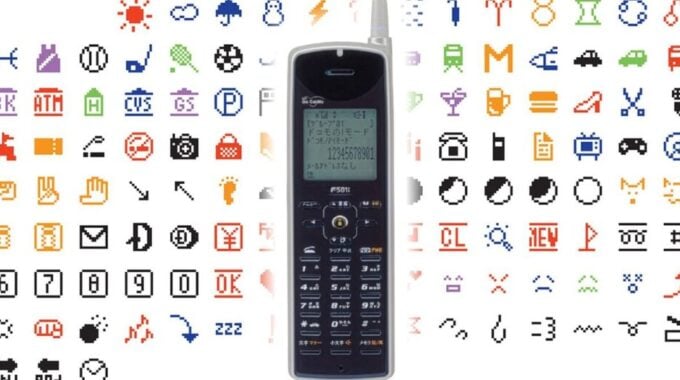
Despite losing the global platform battle, i-Mode’s most lasting innovation was the emoji system created by Docomo employee Kurita Shigetaka. The original set of 176 pictographs launched with the service to help users communicate within the 250-character limit of early mobile text messages. The concept built on existing Japanese pager messaging culture.
Other Japanese carriers developed competing emoji sets, making visual characters a standard part of mobile communication in Japan. The global spread began in 2006 when Google’s Japan team started a project to enable emoji exchange between mobile phones and Gmail. This effort succeeded in 2008, the same year Google proposed adding emoji to Unicode, the international character encoding standard.
Ironically, SoftBank’s Masayoshi Son – whose company competed with Docomo – played a key role in emoji’s worldwide adoption. When SoftBank secured exclusive iPhone rights in Japan in 2008, early sales disappointed partly because the device lacked features Japanese users expected, like mobile TV and wallet functions.
Son directly approached Apple’s Steve Jobs requesting emoji support to boost iPhone sales in Japan. Apple complied in 2009, adding emoji functionality for Japanese iPhones. About 700 emoji joined Unicode in 2010, and Apple enabled the feature globally on iPhones the following year, leading to rapid worldwide adoption.
Today, emoji serves as a universal communication tool that transcends language barriers, perfectly suited to the global platforms operated by Apple and Google. While i-Mode ended its run in 2026, having evolved into what critics called “garak?” phones (a combination of “Galapagos” and “keitai” suggesting insular Japanese development), its emoji legacy continues to shape how billions of people communicate across all digital platforms and devices worldwide.