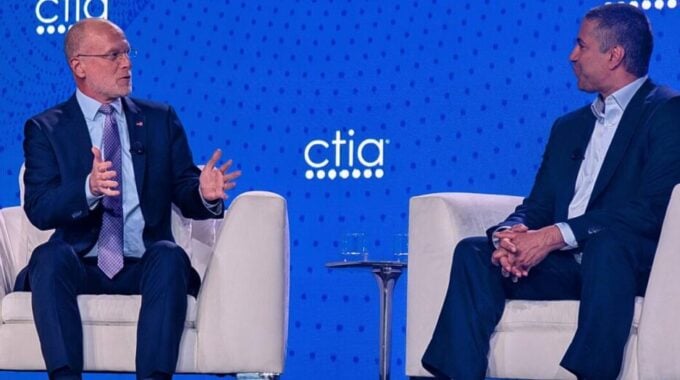
FCC Chair Brendan Carr thinks the satellite-to-phone market needs more players than just SpaceX’s Starlink. Speaking at a wireless industry conference in Washington, Carr said the market should have at least three major competitors offering direct cellular service from space.
The comment highlights growing concerns about SpaceX’s dominance in the satellite connectivity space. Right now, US consumers have limited options for satellite-to-phone service beyond basic messaging, with Starlink being the only provider offering more advanced data services through its partnership with T-Mobile.
“We think the market wants to be, should be, at least three facilities-based providers,” Carr said at the CTIA conference. The timing of his remarks comes as several companies race to challenge SpaceX’s early lead in this emerging market.
Currently, SpaceX’s Starlink offers the most advanced satellite-to-phone service in the US through its T-Mobile partnership. However, the service remains limited to select apps and has seen lower adoption rates than T-Mobile initially expected when it signed the deal in 2022. Two other companies, Skylo and Globalstar, only provide basic messaging services.
Carr highlighted two companies that could shake up the competitive landscape: Amazon and AST SpaceMobile. Amazon plans to launch satellite broadband service from its Leo constellation using compact antennas starting mid-2024. The company also recently announced plans to acquire Globalstar and use its assets to offer direct-to-cell service later.
AST SpaceMobile has taken a different approach, building a smaller constellation of larger satellites. The company has already signed up AT&T and Verizon as customers and aims to start service by the end of 2024. However, AST faced a setback last month when a Blue Origin rocket failed to deliver its seventh satellite into the correct orbit. Carr joked about the mishap: “They’re launching satellites, usually in the right orbit, sometimes not.”
The satellite-to-phone market represents a significant shift in how wireless carriers think about coverage. Traditional cell towers have limitations in rural and remote areas, making satellite connectivity an attractive backup option. The technology could be particularly valuable for emergency communications when terrestrial networks fail.
Carr’s comments also reflect his generally supportive stance toward SpaceX, though he’s pushing for more competition. Last April, he encouraged European telecom companies to choose Starlink over Chinese alternatives. In February, the FCC fast-tracked SpaceX’s application to launch up to 1 million data-center satellites.
The FCC chair also defended SpaceX’s performance on Tuesday, criticizing the agency’s 2022 decision to revoke an $886 million broadband grant from the company. The FCC had argued that Starlink couldn’t meet speed requirements and would cost too much. At the time, speed tests showed median download speeds of 64.5 Mbps, below the required 100 Mbps. Current data shows Starlink now achieves median speeds of 127 Mbps for downloads and 21 Mbps for uploads.
The push for more satellite-to-phone competitors comes as the FCC works to expand wireless access across the country. Carr noted that the agency has resumed spectrum auctions for wireless service and is working to reduce permitting obstacles for broadband infrastructure.