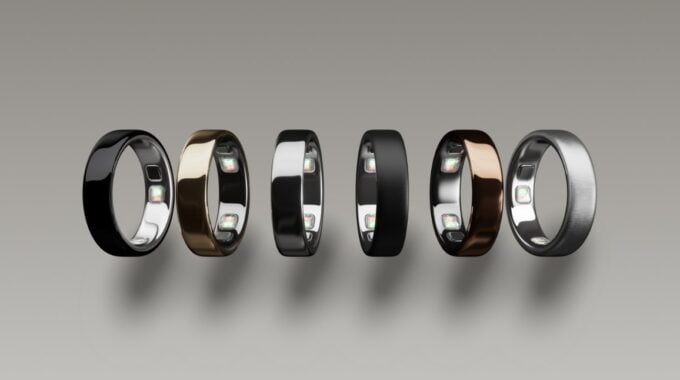
Oura is betting big on miniaturization. The Finnish health tech company announced Oura Ring 5, which it claims is the world’s smallest smart ring at 40% smaller than its predecessor. The new device packs advanced health sensors into a titanium design that promises week-long battery life.
The size reduction matters for wearable adoption. Smart rings have struggled to go mainstream partly because many users found earlier generations too bulky for daily wear. Oura’s latest attempt to solve this could help the company capture more of the growing wearable health market, especially as consumers seek alternatives to smartwatches for continuous health monitoring.
Smaller size, better sensors
Oura completely redesigned the Ring 5’s internal architecture to achieve the dramatic size reduction. The company re-engineered the mechanical, electrical, optical, and battery systems to create what it calls “the most refined silhouette yet.”
The new ring includes:
- Precision-engineered, low-profile sensor domes for better skin contact
- More powerful LEDs for clearer readings
- Twelve stronger signal pathways for better accuracy across different skin tones
- Enhanced scratch resistance with new physical vapor deposition coating
- 100-meter water resistance (IP68 rating)
“To make something 40 percent smaller without sacrificing an ounce of accuracy, we had to rethink every assumption,” said Holly Shelton, Oura’s chief product officer.
Blood pressure monitoring arrives
The Ring 5 introduces Health Radar, Oura’s most significant expansion into proactive health monitoring. The centerpiece is Blood Pressure Signals, which continuously tracks cardiovascular patterns during sleep when readings are most reliable.
The system monitors nighttime blood pressure patterns, alerting users when their metrics suggest increasing cardiovascular strain. This approach targets a key health indicator that’s often invisible until problems develop. Users can also log traditional cuff readings directly in the Oura app to connect manual measurements with ongoing trend data.
Health Radar also includes enhanced nighttime breathing monitoring, giving users a 30-day rolling view of sleep-related breathing patterns and disturbances. This builds on Oura’s recent partnership with ResMed for sleep disorder evaluation and treatment.
Live activity tracking and connected care
Oura is adding real-time workout tracking, letting users start activities and follow key metrics live on their phone. The system works with running, cycling, and strength training, with support for third-party heart rate monitors and lock screen widgets.
The company is also introducing connected care through a partnership with Counsel Health. This brings AI-enabled medical consultations directly into the Oura app, available to members in 43 U.S. states. Users can ask health questions and connect with licensed providers within minutes.
For the growing GLP-1 medication market, Oura added specialized tracking for users managing these treatments. The GLP-1 Insights feature combines medication dosing, side effect tracking, and weight monitoring with Oura’s sleep and activity data.
Pricing and availability
Oura Ring 5 costs $499 for premium finishes (Gold, Stealth, Brushed Silver, Deep Rose) and $399 for base finishes (Silver, Black). The device launches globally on June 4, 2026, with pre-orders starting immediately.
A new Charging Case accessory costs $99 and provides one month of portable battery life with wireless charging support. Oura’s membership service remains $5.99 monthly or $69.99 annually.
The health features roll out gradually through 2026, with most launching in the U.S. first before expanding globally. This staggered approach reflects the complex regulatory environment for health-focused wearables as they move beyond fitness tracking into medical monitoring territory.