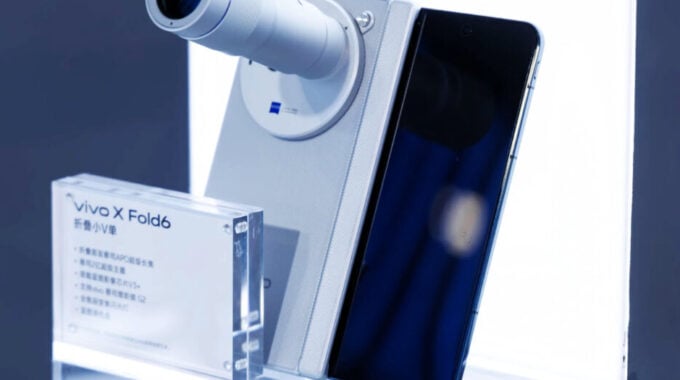
Vivo has officially launched the X Fold6, its newest premium book-style foldable, and on paper it makes some of its rivals look underpowered. With a battery nearly 60% larger than the one in Samsung’s Galaxy Z Fold7, a 200 MP primary camera, and displays capable of 5,000 nits of peak brightness, this phone is clearly aimed at buyers who want the most capable foldable money can buy.
As reported by Notebookcheck, Vivo has also confirmed a global launch for the X Fold6 later this year, though exact markets and pricing outside China haven’t been shared yet. That matters because Vivo has historically kept its foldables close to home, so this marks a shift in strategy.
The X Fold6 replaces last year’s X Fold5 and continues Vivo’s pattern of skipping Pro branding, similar to its approach with the X Fold4. It also joins Google’s Pixel 10 Pro Fold as one of the only book-style foldables to use MediaTek silicon rather than Qualcomm’s Snapdragon chips, which dominate this category.
A chipset that punches above its weight
Vivo put an upgraded version of the MediaTek Dimensity 9500 inside the X Fold6. The company hasn’t spelled out exactly what changed, other than mentioning an improved neural processing unit. Based on existing benchmark data for the standard Dimensity 9500, the X Fold6 should outperform both the Galaxy Z Fold7 and the Motorola Razr Fold, while matching rivals like the Honor Magic V6 and Oppo Find N6.
RAM and storage options are:
- 12 GB RAM / 256 GB storage
- 12 GB RAM / 512 GB storage
- 16 GB RAM / 1 TB storage
- 16 GB RAM / 1 TB storage (Black Gold limited edition)
Battery life could be a real differentiator
The X Fold6 has a 7,000 mAh battery. That’s a significant number in any context, but especially when you consider that the Galaxy Z Fold7 ships with just 4,400 mAh. Foldables typically sacrifice battery size to stay thin, so Vivo is clearly betting that endurance matters more to buyers than a slimmer profile.
Charging speeds are solid too:
- 80 W wired charging
- 40 W wireless charging
Three Zeiss cameras and a detachable telephoto extender
The camera system is built around a triple-lens rear setup, all with Zeiss T* coated glass:
- 200 MP primary camera, f/1.68 aperture, 1/1.4-inch Samsung ISOCELL HPB sensor
- 50 MP ultra-wide camera, f/2.05 aperture, 1/2.76-inch Samsung ISOCELL JN1, 16 mm equivalent
- 50 MP telephoto camera, f/2.57 aperture, 1/1.95-inch Sony LYT-602, 70 mm equivalent, 3x optical zoom
- 20 MP selfie cameras on both displays, f/2.4 aperture
Vivo also sells a Telephoto Extender Gen 2 accessory separately. Clip it on and the effective focal length stretches to 200 mm. The catch is that it adds 153 g to a phone that already weighs between 228 g and 235 g depending on the variant. It’s optional, but it does make the X Fold6 feel more like a modular camera system than a typical smartphone.
Two sharp displays in a slim frame
The cover display is a 6.51-inch AMOLED panel from BOE, running at 2,528 x 1,120 pixels with a 424 PPI pixel density and a 120 Hz refresh rate. Open the phone and you get an 8.02-inch foldable inner display with the same pixel density, brightness ceiling, and refresh rate. Both panels top out at 5,000 nits, which is competitive with the best flat-screen flagships available right now.
The phone is 9.4 mm thick in most finishes, rising to 9.9 mm for the blue glass-back version. It also carries an IP59 rating for water resistance.
Pricing and availability
In China, the X Fold6 starts at CNY 7,999, which is roughly $1,175 at current exchange rates. Pricing scales up from there:
- CNY 8,999 (~$1,322) for 12 GB RAM / 512 GB storage
- CNY 9,999 (~$1,469) for 16 GB RAM / 512 GB storage
- CNY 10,999 (~$1,616) for 16 GB RAM / 1 TB storage
- CNY 11,299 (~$1,660) for the Black Gold limited edition with 16 GB RAM / 1 TB storage
The Telephoto Extender accessory costs CNY 999 (~$147) on its own. Vivo also sells a “Professional Imaging Suite” bundle starting at CNY 11,999 (~$1,764) that includes the extender with a higher-spec base configuration.
Global pricing will almost certainly differ, and Vivo hasn’t announced which markets will get the phone first. Given that comparable foldables from Honor and Oppo have made it to Europe and select Asian markets this cycle, there’s reason to think Vivo will follow a similar path.