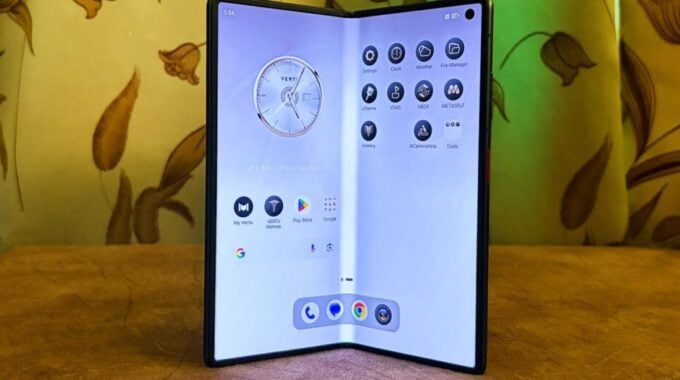
Luxury phone maker Vertu is not interested in competing with Apple or Samsung on specs. The UK-founded brand has always sold status, and its latest device, the Alphafold, takes that logic a step further by adding an AI agent designed to automate a chief executive’s working day. At $6,880 to start, it is not aimed at mainstream buyers. It is aimed at people who already have an assistant and want a digital one too.
According to TechCrunch, the device was tested not as a typical smartphone review, but as a genuine executive tool. That means skipping camera comparisons and benchmark scores in favor of real workflows: analyzing contracts, planning business trips, managing schedules, and letting the AI run multi-step tasks from start to finish. The central question was not whether this is a good phone. It was whether it is worth the money to someone running a company.
The short answer is: not yet. The hardware is striking, the concept is credible, and the AI occasionally impresses. But the overall experience has too many rough edges to justify the price, especially when a Samsung Galaxy Z Fold 7 does most of the same things for far less.
What you actually get for $6,880
The Alphafold is a foldable phone wrapped in genuine calfskin leather with titanium accents. It arrives in packaging that looks more like a jewelry box than a phone box, complete with neatly arranged drawers holding a leather sleeve and charging cables. Vertu clearly wants the unboxing to feel like an event.
At 264 grams, the device is noticeably heavier than Samsung’s Galaxy Z Fold 7, which comes in at 215 grams. The weight is never uncomfortable, but it is hard to ignore during long sessions. The curved frame makes the phone easier to unfold one-handed than Samsung’s flatter design, though Samsung’s device feels sleeker and more comfortable to hold when closed.
Beneath the premium exterior, though, the hardware tells a different story. During testing, strong similarities appeared between the Alphafold and the ZTE Nubia Fold, a phone that retails for around $1,100. The hinge design, dimensions, speaker placement, microphone layout, and fingerprint reader position all looked familiar. System information also showed ZTE identifiers in parts of the software.
When asked about this, Vertu confirmed to TechCrunch that the Alphafold was developed through a supply-chain partnership with ZTE and Nubia covering hardware, component integration, and production engineering. Vertu said it handled the luxury materials, software experience, quality control, and after-sales service. ZTE did not respond to a request for comment. This is not new behavior for Vertu. Wired reported something similar in 2023 when reviewing the MetaVertu, noting hardware similarities to a ZTE Nubia handset.
Meet Hermes, Vertu’s AI agent
The Alphafold’s real pitch is not the leather back. It is Hermes Agent, a pre-installed AI assistant built on the open-source Hermes project. Unlike standard phone AI assistants that respond to one prompt at a time, Hermes is designed to execute multi-step workflows across apps, analyze files, remember conversations, and escalate requests to a human concierge when needed.
That is a genuinely interesting idea. Most AI phone features still feel like glorified search boxes. An agent that can string tasks together and take action on your behalf is a different category entirely. Whether Hermes actually delivers on that promise is another matter.
How Hermes performed in real testing
Testing covered several scenarios that reflect how an executive might actually use the device. Here is what happened.
Pre-travel task chain: Hermes was asked to message a contact about running 20 minutes late, open navigation to the airport, switch the phone to Do Not Disturb, and set a reminder to call the hotel in 15 minutes. It sent the message, enabled Do Not Disturb, and opened Google Maps. But it did not start navigation automatically, and it set the reminder for 9:08 p.m. even though the request was made at 2:32 a.m. Running the same test on Samsung’s Galaxy Z Fold 7 with Gemini produced a different result. Gemini asked clarifying questions first, including which airport and where to save the reminder, then set the correct time. Hermes acted faster but got it wrong. Gemini was slower but accurate.
Business trip planning: Hermes was asked to organize a trip from Mumbai to Pune, find a morning flight, recommend a hotel, and add the itinerary to the calendar. The agent correctly noted no direct morning flights were available and offered to escalate to Vertu’s concierge. However, it created a calendar entry for the wrong dates entirely. Gemini on the Samsung device also found no suitable flights but kept working, suggesting alternative travel options instead of stopping.
Document analysis: Both agents were asked to analyze a locally saved financial spreadsheet and summarize quarterly results. Hermes handled the initial upload well and correctly summarized the Q2 figures. When the same conversation was reopened days later, it no longer recognized the document and asked for it to be uploaded again. Gemini required an upload the first time too, but retained the context across days and answered follow-up questions about the document without needing the file again.
The pattern across all three tests was consistent. Hermes is more willing to act without asking questions, which sometimes makes it feel more like a true agent. But that willingness also leads to mistakes that a more cautious system would avoid.
Specialist AI agents and the concierge layer
Beyond general assistance, the Alphafold includes specialist AI agents aimed at affluent professionals. These cover areas like:
- Legal guidance and contract summaries
- Investment insights and financial briefings
- Business data access through an integrated ERP system
- Escalation to a human concierge for tasks the AI cannot complete
The concierge option is worth noting because it implicitly acknowledges the limits of what Hermes can do reliably. When the AI cannot finish the job, a person steps in. That hybrid model is sensible, but it also raises the question of whether the AI layer is mature enough to justify the price premium on its own.
The specialist agents should be treated as starting points, not authoritative advisers. Their outputs are AI-generated and need independent verification before being used for anything legally or financially significant.
Security claims and what can be verified
For executives who might use this phone to analyze contracts or financial reports, data security is not optional. Vertu says conversations with Hermes Agent are encrypted and are not used to train public AI models. The company also says users can choose where their data is processed, with enterprise deployments supporting private infrastructure.
The Alphafold includes a dedicated security chip called the A5, which Vertu says provides hardware-level protection for sensitive data, encrypted communications, and digital credentials. These claims could not be independently verified during testing. They are central to Vertu’s pitch to enterprise buyers, but prospective customers should ask for documentation rather than taking them at face value.
Battery, camera, and everyday use
Away from the AI features, the Alphafold works like a modern flagship foldable. Battery life easily lasted more than a day during testing, which is solid. The camera includes a document scanning mode under a Smart AI setting that recognizes paperwork and saves enhanced versions, which is genuinely useful for digitizing contracts and receipts on the go. Samsung offers a comparable scanning experience through its own camera software, so this is not a differentiator.
One glaring omission for a $6,880 phone: no wireless charging. Samsung’s Galaxy Z Fold 7 supports Qi wireless charging alongside USB-C. Vertu’s device does not, which feels like a meaningful oversight at this price point.
The verdict: ambitious, but hard to justify
The Alphafold is a serious attempt to build an AI-first luxury smartphone for executives. The concept is credible, the materials are genuinely premium, and Hermes Agent has moments where it feels like something different from what other phones offer. But the execution does not match the price.
- The core hardware appears to be based on a ZTE Nubia platform that sells for around $1,100
- Hermes Agent produces inaccurate results in workflows where accuracy matters most
- Document memory and task consistency were inconsistent across testing
- No wireless charging at $6,880 is a real miss
- Samsung’s Galaxy Z Fold 7 offers a more polished foldable experience at a fraction of the cost
Vertu is asking buyers to pay a significant premium for branding, craftsmanship, and an AI platform that is still being refined. With Samsung’s Galaxy Z Fold 8 expected soon, the gap between what the Alphafold offers and what mainstream flagships provide is only going to narrow further. For most executives, the smarter move is to wait.