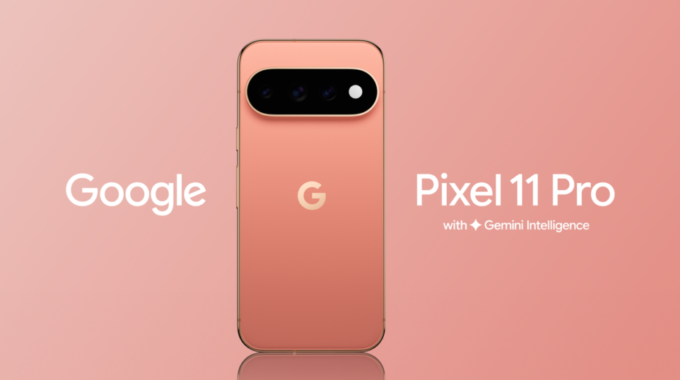
A 40% thinner camera bar. That’s the detail that caught my attention first. Not the AI, not the chip benchmarks — the fact that Google looked at one of the most recognizable design signatures in Android and made it smaller, flatter, and less annoying to carry around. It’s a small thing. But it tells you a lot about where Google’s head is at with the Pixel 11 series.
Google has announced the Pixel 11, Pixel 11 Pro, and Pixel 11 Pro XL, and this is clearly the most complete Pixel lineup the company has put together. Better cameras, a new in-house chip, a fun new hardware notification system, and pricing that starts at $899. Pre-orders are open now, with phones hitting shelves on August 20.
Design and display: finally, a phone that sits flat on a table
All three phones get an edge-to-edge glass look across that iconic camera bar. But on the standard Pixel 11, the bar is 40% thinner than before, which means the phone is almost completely flat when you use a Made by Google case. No more wobble on your desk. No more that-thing-sticking-out-of-your-pocket problem. Small win, real impact.
The Pixel 11 has a satin metal frame, polished glass back, and a bright Actua display. It comes in Pistachio, Hibiscus, Frost, and Obsidian. The Pro models get Google’s brightest display yet at up to 3,600 nits, plus a new anti-scratch coating that’s more than double the scratch resistance of the previous generation. Pro colors this time around are Canyon, Fog, Olive, and an all-matte Obsidian. All three phones start at 256GB of storage, which should be the baseline by now honestly.
Charging got a big upgrade too. All three phones support Qi 2.2 at 25W wirelessly, and the Pixel 11 Pro XL can deliver 15 hours of battery life from just 15 minutes of wired charging. That’s a claim worth testing, but if it holds up in real use, it’s a meaningful change for heavy users.
HiLight: the notification LED is back, but smarter
This one’s exclusive to the Pro models, and I think it’s genuinely interesting rather than a cheap gimmick. HiLight uses colored LED lights built around the camera flash to give you glanceable information without you having to touch your phone. When your phone is face down, it can glow to tell you Gemini is listening, thinking, or responding. You can also assign custom colors to specific contacts, so you know at a glance whether that incoming call is worth picking up.
It’s a bit like the old notification LEDs from Android phones of the early 2010s, but smarter and more intentional. Google says more features are coming over time, including message notifications from favorite contacts. So this is a platform they’re building on, not a one-trick feature.
Camera upgrades that go well beyond spec-sheet numbers
The camera improvements are where this launch really gets interesting. Here’s what you’re getting across the lineup:
- Pixel 11 gets a new 48MP main sensor with 56% more light sensitivity
- The 5x telephoto on Pixel 11 now supports 30x Super Zoom
- Pixel 11 Pro and Pro XL get a brand new main sensor and an upgraded 48MP telephoto with 30% more light sensitivity
- Portrait Mode is now available at 5x on Pro models
- Pro Zoom goes all the way to 120x on the Pro models
- Night Sight captures up to 4.5x faster than before, with no quality drop
The Night Sight improvement is the one I’d actually use every day. Faster low-light shots with the same quality means less blur, less waiting, more keepers. That matters more than hitting 120x zoom, which most people will try once and forget about.
Tensor G6: a chip with a point of view
Google’s new Tensor G6 is doing a lot of heavy lifting here. It’s 25% faster for web browsing, 15% quicker at launching apps, and processes on-device AI tasks up to 3.5 times faster while using 3.5 times less energy. That last number is the one that should get attention, because efficient AI processing means longer battery life and faster Gemini responses without constantly pinging the cloud.
The chip also works alongside a new Titan M3 security chip to bring post-quantum cryptography to the device. That’s Google future-proofing against the kind of threats that don’t fully exist yet but are coming. And according to a new report by Counterpoint Research, Pixel’s AI experience has the strongest privacy protection of any phone right now. Bold claim. Worth watching how that holds up under scrutiny.
Price, availability, and what you actually get
Pixel 11 starts at $899, Pixel 11 Pro at $1,099, and Pixel 11 Pro XL at $1,299. All three come with seven years of OS, security, and Pixel Drop updates. Pro buyers also get six months of Google AI Pro, which includes higher Gemini usage limits, 5TB of cloud storage, and Google Health Premium. New cases are also launching, including a clear option, plus new Pixelsnap Ring Stand colors.
Pre-orders are open today at the Google Store and retail partners, with shipping starting August 20. If you’ve been on the fence about switching to Pixel, this is the strongest argument Google has made in a while.