A replacement battery for $40. A new screen for $90. No technician, no repair shop, just you and a simple tool. That’s the pitch Fairphone is making with the Gen 6+, and honestly, it’s a more compelling argument than most flagship specs sheets.
According to Android Police, the Fairphone Gen 6+ is heading to the US with stock Android 16 on board, not Murena’s e/OS like its predecessor. That’s a big deal. Murena’s software is fine for privacy-focused power users, but it’s a tough sell for anyone who just wants a phone that works out of the box. Android 16 changes the story entirely.
You’ll be able to pick one up directly from Fairphone or through Amazon, and it plays nicely with AT&T and T-Mobile. So the usual US compatibility headaches are off the table this time.
What’s new under the hood
The Gen 6+ shares its design with the standard Gen 6, but Fairphone swapped in a Qualcomm Snapdragon 7S Gen 4 processor paired with 12GB of LPDDR5 RAM. That puts it in the same performance neighborhood as the Nothing Phone 4a. It’s not flagship territory, but it’s a meaningful step up from a lot of midrange competition.
Other specs include 256GB of storage, a microSD card slot, NFC, 5G with US-compatible bands, and dual-SIM support. So the basics are covered, and then some.
The part that actually makes this phone special
Here’s where things get interesting. The Gen 6+ has 12 replaceable components that you can swap out at home with a basic tool. No glue guns, no suction cups, no YouTube tutorial rabbit holes. We’re talking:
- Battery
- Display
- All three cameras
- Both rear panels
- Speaker
- USB-C port
This matters more than people realize. Software support promises are great, but a phone with a dead battery at year four isn’t useful to anyone. With the Gen 6+, you just buy a new $40 battery and keep going. Drop it and crack the screen? $90 and you’re back. That’s a completely different relationship with a device compared to anything Apple or Samsung is selling right now.
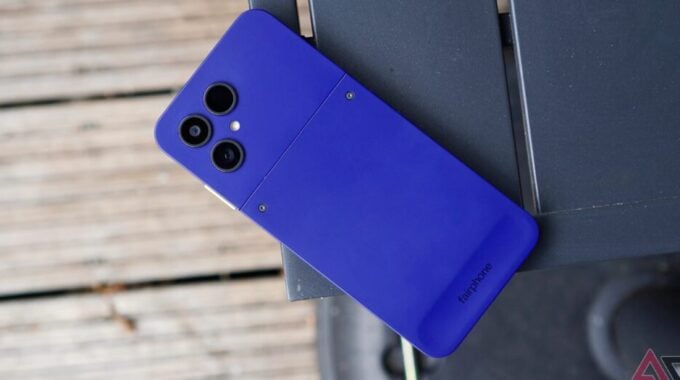
There’s also some personality in the accessories. The rear panel can be swapped for a cardholder, a finger loop, or a lanyard attachment. Small things, but they show Fairphone isn’t treating modularity as purely utilitarian.
What it’s actually like to hold and use
The review unit is Cobalt Blue, a rich royal blue chosen to mark Fairphone co-founding the Fair Cobalt Alliance. It’s a genuinely nice color, refreshingly bold compared to the washed-out palettes Samsung tends to roll out. The phone is light at 191 grams, though it is a bit chunky at 9.6mm thick.
There are a few rough edges. The fingerprint sensor sits flush with the frame and can be tricky to find quickly. The bezels are noticeable. And the Corning Gorilla Glass 7i on the screen attracts fingerprints like a magnet, which is annoying at any price point.
But Android 16 runs clean. Outside a Fairphone app and an incoming Gallery app, there’s no bloatware to speak of. That’s genuinely rare and worth calling out.
Pricing and who it’s up against
The Fairphone Gen 6+ costs $650, which puts it against the Google Pixel 10a, Samsung Galaxy S25 FE, Nothing Phone 3, Honor 600, and the Galaxy A57. None of those phones let you replace the battery in your kitchen on a Tuesday afternoon. Software update commitments across that group also vary widely, while Fairphone is promising support through 2033, matching Google and Samsung’s best commitments.
So yes, $650 is real money. But when you factor in that you can repair this thing yourself, multiple times over, for years, the value calculation shifts. It’s not the most powerful phone at this price. But it might be the smartest long-term buy.