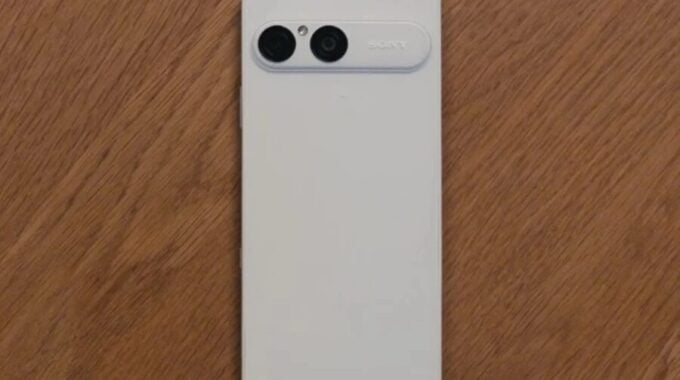
Sony just confirmed everything the leaks already told us. The Xperia 10 VIII is official, and if you were hoping for a big shake-up, you might want to sit down. The company has officially launched its latest mid-range phone with the same Snapdragon 6 Gen 3 chip that powered last year’s Xperia 10 VII. Same chip. Different year. That’s the headline.
To be fair, Sony hasn’t completely phoned this one in. The Xperia 10 VIII keeps the clean, notch-free design that the brand has stuck with for years, and honestly, it still looks better than most phones in this price range. The side bezels are slim, and yes, the top and bottom bezels are thicker than what you’d see on a Samsung or a Motorola at this price. But Sony fans know the deal by now. Up front, there’s a 6.1-inch OLED display running at 120Hz, and Sony says it’s 50% brighter than the screen on last year’s model. That’s a meaningful upgrade if you spend any time outdoors with your phone.
The familiar camera shutter button is back on the right side, which is one of those small things Sony gets right that nobody else bothers with. The dual speakers have also been updated, with Sony claiming fuller, richer sound. Around the back, you get a dual-camera system with a 50MP main shooter on a 1/1.56-inch sensor and a 13MP ultra-wide. It’s a reasonable setup for a mid-ranger, though Sony hasn’t done anything bold here to make the camera stand out from the competition.
Battery life is unchanged at 5,000mAh, and Sony is still promising up to two days on a single charge. That’s a claim worth taking with a pinch of salt until real-world tests come in, but Sony’s battery optimization has been solid in past models, so it’s plausible.
The most interesting new addition is actually a software trick. Sony added a Point and Pay feature that lets you double-press the power button to pull up payment QR codes and loyalty cards. It’s a small convenience feature, but it’s the kind of thing that genuinely makes daily life a little smoother for people who live out of their wallets. So that’s something.
But back to that chip. The Snapdragon 6 Gen 3 is a capable processor, no question. The issue is that anyone upgrading from an Xperia 10 VII is going to feel exactly zero difference in raw performance. For a phone launching at 599 euros (roughly $698 USD), that’s a hard sell. Sony is positioning this squarely in the premium mid-range tier, but at that price, you’re brushing up against phones with significantly more powerful silicon.
Here’s the bigger picture. Sony has always played it conservative with the Xperia 10 line, treating it as a reliable, understated option rather than a spec warrior. That approach has a loyal audience. But the mid-range market in 2026 is brutally competitive, with brands like Motorola, Samsung, and Google all pushing harder on value. Sony isn’t really competing on specs or price here. It’s competing on brand identity, build quality, and software polish. Whether that’s enough at 599 euros is a real question.
The Xperia 10 VIII ships with Android 16 and 8GB of RAM with 128GB of storage. It launches in Europe from mid to late September. A quick look at what you’re getting:
- 6.1-inch OLED display, 120Hz, 50% brighter than predecessor
- Snapdragon 6 Gen 3, 8GB RAM, 128GB storage
- 50MP main camera with 1/1.56-inch sensor plus 13MP ultra-wide
- 5,000mAh battery with two-day claim
- Point and Pay double-press power button shortcut
- Android 16 out of the box
- Priced at 599 euros, launching in Europe mid to late September
If you’re already in the Sony ecosystem and happy with your Xperia 10 VII, there’s not a strong reason to jump. But for someone coming from an older Sony phone or a different brand entirely, the brighter screen, clean software experience, and that physical shutter button still make a case. Just know what you’re paying for.