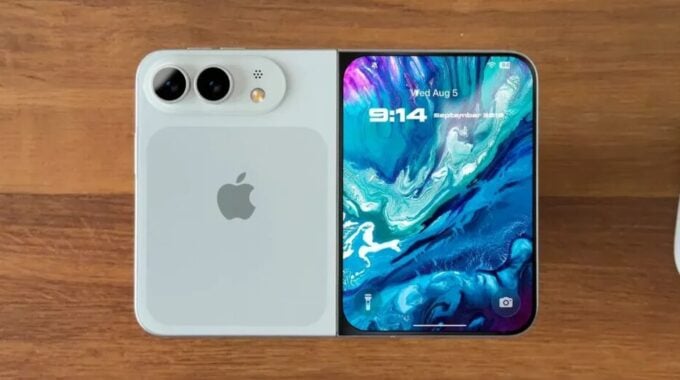
Apple’s first foldable phone is almost here, and somehow the most alarming thing about it isn’t the hardware. It’s the price tag. If recent leaks are anywhere close to accurate, the iPhone Ultra could cost more than $2,600 at the low end and push past $3,000 depending on where you live. Sound familiar? It should.
According to Phone Arena, two separate price leaks have been floating around online ahead of Apple’s September 9 event. The first came from a screenshot allegedly showing a Vodafone Egypt listing, with the iPhone Ultra priced at 155,750 Egyptian pounds, which converts to roughly $3,056. Vodafone Egypt later reached out to Phone Arena to say no such leak came from their end, and the screenshot couldn’t be verified while it was supposedly live. So take that one with a grain of salt.
The second leak came from an Australian user on X, who claimed a contact at Vodafone Australia shared local pricing. That leak put the 256GB model at 3,699 AUD (about $2,663), the 512GB at 4,199 AUD (roughly $3,023), and the 1TB version at 4,699 AUD (around $3,382). Neither leak is confirmed, but the numbers line up closely enough with earlier analyst predictions that people aren’t laughing them off.
This is where the Apple Vision Pro comparison becomes hard to ignore. The Vision Pro launched at $3,499 with a genuinely impressive tech package, and it still flopped. The problem wasn’t just comfort or software — it was that the price made it a hard sell for almost everyone. Apple positioned it as a first-generation product for early adopters, and most people passed. The iPhone Ultra is walking into a similar situation, except the foldable phone market isn’t new territory anymore.
Foldable phones have been around for close to a decade. Samsung is now on its eighth generation of the Galaxy Z Fold, and the Fold 8 starts at $1,899. That’s still expensive, but it’s a product you can actually go buy today at Verizon or AT&T. You don’t need to track down an import or rely on a friend in another country. Samsung also matched the wide, passport-style aspect ratio that the iPhone Ultra is expected to use, which means Apple’s biggest rival is already selling a direct competitor for potentially $700 less.
And then there’s the availability problem. Analyst Ming-Chi Kuo, who has a strong track record on Apple supply chain reporting, suggested Apple could repeat the 2017 iPhone X playbook — a September event with actual shipments pushed to late October or November. Other supply chain reports are even less optimistic, with some pointing to limited US-only availability stretching into spring 2027. That’s a rough combination: high price, short supply, and a long wait.
To be fair, an iPhone foldable is still genuinely exciting. Apple tends to refine things in ways competitors don’t always bother with, and there’s real curiosity about what software experience it brings. But excitement doesn’t justify a $3,000 price point when Samsung is eight generations deep and selling a comparable device for less right now.
Apple has time before September 9 to prove the skeptics wrong. But based on everything leaking out, the iPhone Ultra is shaping up to be a device that costs too much and won’t be easy to get. That’s not a great opening act for Apple’s foldable era.