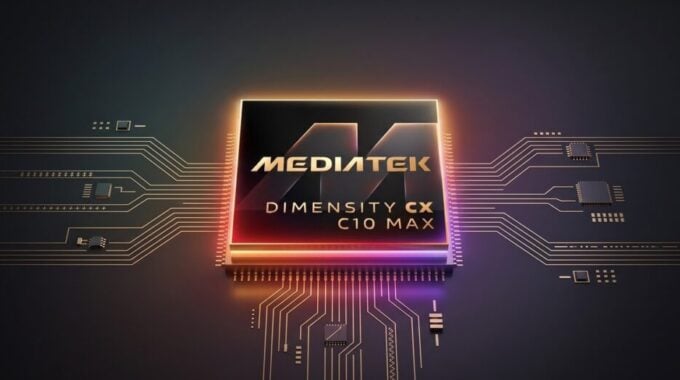
Fifty-five TOPS of local AI processing in a fanless laptop chip. That’s the number MediaTek is leading with, and honestly, it’s a pretty compelling opening move for a company that’s never really played in the high-end laptop space before.
MediaTek has announced the Dimensity CX C10 Max, the first chip in its new Dimensity Compute Experiences family. Built on TSMC’s 3nm process, it’s designed specifically for Google’s incoming category of thin, fanless “Googlebook” laptops running ChromeOS. This is MediaTek’s official push into ARM laptops, and they’re not tiptoeing in.
The chip uses an all-big-core CPU setup with eight cores total: one Cortex-X925, three Cortex-X4 cores, and four Cortex-A720 cores. Backing that up is an 11-core Arm Immortalis-G925 GPU, 12MB of L3 cache, and LPDDR5X memory support at 9,600MT/s. That last number matters because it’s a step up from the 8,533MT/s ceiling on MediaTek’s previous Kompanio Ultra 910. Faster memory means smoother multitasking, and in a thin laptop that can’t rely on active cooling, efficiency at every level counts.
The AI story is where MediaTek is putting most of its chips, so to speak. The integrated NPU 890 is rated at 55 TOPS, which puts it ahead of the first-gen Qualcomm Snapdragon X Plus at 45 TOPS and Intel’s Lunar Lake at around 48 TOPS. It’s roughly on par with AMD’s Ryzen AI 300 series. The whole point is running Google’s Gemini features, like Magic Pointer and real-time contextual assistance, directly on the device instead of routing everything through the cloud. Faster responses, better privacy. That’s the pitch, and it’s a reasonable one.
Connectivity is solid across the board:
- Wi-Fi 7 with theoretical speeds up to 7.3Gbps
- Dual-engine Bluetooth 6.0
- Imagiq 1090 ISP with support for 32MP camera sensors
- AI-assisted HDR video, smooth zoom, and auto-focus for video calls
MediaTek has been clear that the C10 Max is targeting Qualcomm’s first-gen Snapdragon X Elite, not the newer hardware. Some will call that sandbagging. But it’s also just honest positioning for a first-gen product in a new market. Internal tests on ChromeOS R133 reference boards show up to 15% faster multi-threaded performance at 12W and 50% lower power draw in single-threaded tasks versus a Windows 11 Samsung Galaxy Book 4 Edge. Battery life projections sit at up to 19 hours on a 60Whr reference system.
So why does this matter beyond benchmark slides? Because Qualcomm has had the ARM Windows and ChromeOS laptop space mostly to itself at the high end. MediaTek entering with real specs, a competitive NPU, and deep Google integration changes that. More competition means better pricing and faster improvement cycles for buyers. MediaTek’s smartphone chips have been seriously impressive on efficiency lately, and a fanless Googlebook is exactly the kind of device that rewards that kind of discipline. The real test comes when retail units hit reviewers and we see how the chip holds up under sustained workloads without a fan to bail it out.