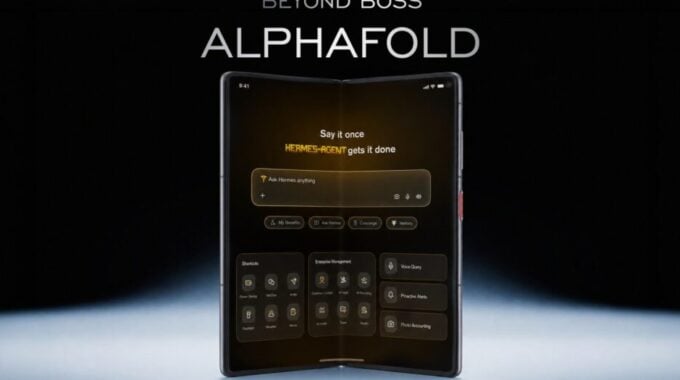
Luxury smartphone brand Vertu unveiled a foldable phone powered by an AI agent that connects with enterprise software and coordinates workflows. The company is targeting executives who manage business operations and communications on the move.
Called the Alphafold, the foldable smartphone starts at $6,880 for the calfskin version. Higher-end models feature bespoke finishes including alligator leather, 18K gold, and natural diamond accents, with the company’s highest-end standard model priced at $46,800.
The launch marks Vertu’s latest attempt to stay relevant in the modern smartphone market. The Hong Kong-based company once dominated the luxury handset space before the iPhone era but has changed ownership multiple times as mainstream manufacturers took over. Now Vertu is betting on combining luxury hardware with enterprise-focused AI to create a new niche.
This strategy makes sense given current market gaps. Existing AI features on smartphones from major manufacturers focus mainly on consumer tools like image editing and voice assistance. This leaves room for more advanced AI workflows tied to enterprise systems, especially as businesses look for mobile solutions that can handle complex workflows.
The Alphafold comes with Hermes Agent, built on the open-source Hermes project by Nous Research. The agent can connect to enterprise systems like ERP and CRM platforms to coordinate tasks through natural-language prompts:
- Approvals and scheduling
- Sales tracking and reporting
- Travel planning coordination
- Operational reporting
The device can route requests across multiple AI models including OpenAI’s GPT, Anthropic’s Claude, Google’s Gemini, and selected open-source models. It also integrates with more than 80 apps and dozens of native phone functions for cross-platform workflows.
Vertu CEO Molly Ma pointed to earlier AI-agent smartphone experiments in China that gained popularity before facing challenges over data privacy and cloud-based data collection. The Alphafold aims to address those concerns through a privacy-focused architecture featuring a proprietary A5 security chip.
This security approach could be significant for enterprise adoption. The chip is designed to isolate authentication keys, biometric credentials, and sensitive enterprise information from the main operating system. Commercially sensitive data can be processed locally on the device, while prompts sent to external AI models are redacted or tokenized before leaving the phone.
However, the company has not yet completed third-party security audits or independent certification. Vertu said independent audits remain on its security roadmap as “an explicit next-stage commitment” and promised to communicate progress publicly as the product develops.
The hardware specifications match premium foldable standards. The Alphafold runs on Qualcomm’s Snapdragon 8 Gen 4 processor and features an 8.05-inch foldable display alongside a 6.53-inch outer screen. It includes a 6,500mAh battery, satellite communication capabilities, and a triple rear camera setup with 50-megapixel primary and ultrawide cameras plus a 5-megapixel telephoto lens.
The device represents an evolution from Vertu’s previous AI efforts. The company introduced Agent Q last year, a clamshell-style foldable focused on AI automation. Ma said the Alphafold represents a significant step forward, noting that AI-agent technology has improved rapidly over the past year in areas like memory, automation and app integration.
Vertu faces an uphill battle in a challenging market segment. Foldable smartphones remain niche globally despite years of investment by Samsung and Huawei. About 20 million foldable smartphones shipped globally in 2025, accounting for less than 2% of total smartphone shipments, according to IDC data. The average selling price was around $1,300 – roughly three times the cost of regular smartphones.
IDC’s Kiranjeet Kaur noted that foldables could benefit from AI-agent workflows because their larger displays suit multitasking and productivity experiences. But she added that enterprise AI adoption on smartphones still lags behind computers, and most enterprise smartphone decisions focus on ecosystem integration and device management rather than AI capabilities.
The first 115-unit batch of Vertu’s Alphafold begins shipping this week across major markets including the U.S. Whether executives will pay premium prices for AI-powered luxury remains to be seen, but Vertu is betting that combining status symbol appeal with genuine business functionality can create a sustainable niche in the crowded smartphone market.