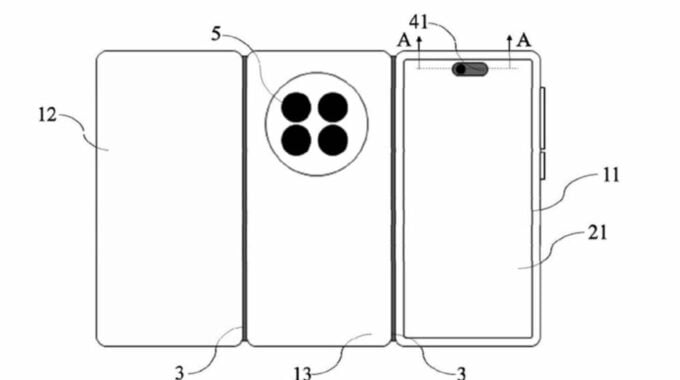
Huawei’s next tri-fold phone is already turning heads, and it hasn’t even been announced yet. New patent images of the Mate XT 2 have surfaced online, giving a clear look at what the company is planning for its follow-up to the original Mate XT. The changes go beyond cosmetic tweaks.
According to Huawei Central, the patent shows a U-shaped tri-fold design, a notable shift from the reverse-Z fold mechanism used in the original Mate XT. The images also point to changes in the camera module layout, suggesting Huawei is reworking more than just the hinge.
The original Mate XT launched in 2024 and was widely seen as a technical achievement. It was the first mass-market triple-fold phone, and demand outpaced supply for months. The Mate XT 2 appears to be building on that foundation with structural improvements that could make the device more practical to use day to day.
The U-shaped fold design is worth paying attention to. Unlike the original’s fold pattern, a U-shape means both outer panels fold inward toward the center, which can result in a flatter, more even profile when closed. That matters for a phone this size, where any gap or unevenness between panels tends to be more noticeable.
The patent images also show a repositioned or redesigned camera module, though the exact specifications aren’t confirmed yet. Camera placement on foldables is always a tricky engineering problem because the folding mechanism limits where components can sit without affecting the hinge or the screen.
A few things stand out from what the patent reveals:
- A U-shaped tri-fold hinge replaces the earlier reverse-Z mechanism
- The camera module appears to have a different layout compared to the Mate XT
- The overall form factor looks slimmer when folded
It’s worth remembering that patents don’t always translate directly into shipping products. Companies file patents regularly, and designs often change between the patent stage and final production. That said, these images align with the direction Huawei has been moving, and the Mate XT 2 is expected to arrive sometime in 2025.
The broader context here is that the foldable phone market is getting more competitive. Samsung, Google, and a handful of Chinese brands are all pushing into the space. Huawei, despite operating under US trade restrictions that limit its access to certain chips and software, has managed to stay relevant by doubling down on hardware innovation. A refined tri-fold could help it hold that position heading into a year where foldable competition is likely to intensify.