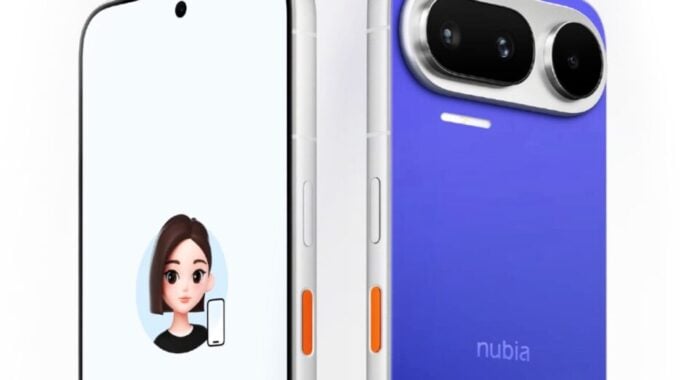
ZTE has announced the Nubia NaviX Ultra, calling it the world’s first AI agent smartphone. The idea is bold: instead of relying on conventional apps, the phone puts AI agents front and center as the primary way users interact with their devices. It’s an ambitious pitch, but right now, ZTE is keeping almost everything under wraps.
No specs, no price, no confirmed software details. What ZTE has shared is a single image showing the phone in four colors, white, pink, blue, and black, along with a promise that more information is coming. The full picture is expected at the World Artificial Intelligence Conference (WAIC) 2026, running July 17 to 20.
The concept of replacing apps with AI agents has been floating around the tech industry for a couple of years now. Major players like Google, Apple, and Microsoft have all explored the idea, but none has fully committed to making it the core of a consumer product. Most phones today still run traditional apps, with AI layered on top to make things easier. ZTE is apparently betting it can go further than that.
From what’s visible in the released images, the NaviX Ultra has a clean, modern look. A few design details stand out:
- Exceptionally thin bezels with a centered punch-hole camera
- A metal frame with visible antenna bands
- A dedicated orange AI button alongside the standard volume and power controls
- A triple-camera module styled similarly to the Apple iPhone Air, with an elongated LED flash underneath
The camera layout comparison to the iPhone Air is worth noting. Apple’s influence on smartphone design is obvious across the Android market right now, and ZTE is clearly not shying away from that aesthetic.
One of the biggest unknowns is whether the NaviX Ultra runs Android at all. ZTE has confirmed it includes a Doubao AI assistant, which is a product from ByteDance, the company behind TikTok. Beyond that, it’s unclear whether users will have access to the Google Play Store, standard Android apps, or something else entirely. That question matters a lot, particularly for anyone outside China, where many Google services are unavailable regardless.
The broader context here is that the smartphone market is desperately looking for its next big thing. Sales growth has slowed significantly over the past few years, and AI has become the industry’s main pitch to get people to upgrade. If ZTE can actually deliver a phone where AI agents handle tasks that would normally require switching between multiple apps, it could be genuinely interesting. But the history of “world’s first” claims in consumer tech is littered with products that didn’t live up to the marketing.
Everything hinges on what ZTE reveals at WAIC 2026. Until then, the NaviX Ultra is a striking-looking phone with an intriguing concept and no confirmed substance behind it.