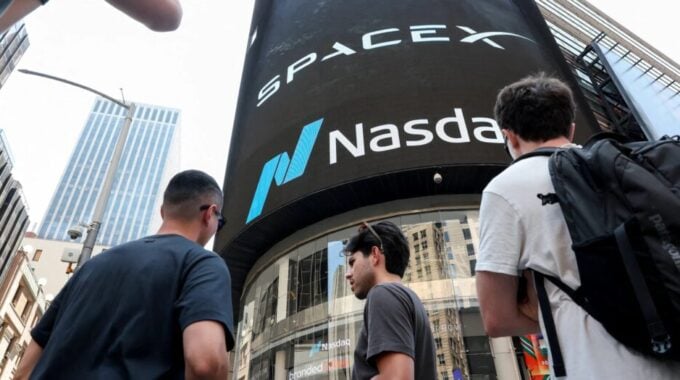
Verizon, AT&T, and T-Mobile shares all dropped this week, and SpaceX didn’t have to launch a single rocket to make it happen. All it took was a few sentences from SpaceX President Gwynne Shotwell on a post-earnings call, and suddenly the entire U.S. wireless industry had a new problem to worry about.
As reported by Reuters, Shotwell confirmed that SpaceX plans to build out terrestrial, ground-based infrastructure to turn Starlink into what she called “a true mobile service.” She also said the company expects to win “quite a few” customers away from the big three carriers. Shares of Verizon, AT&T, and T-Mobile fell between 1% and 2.4% in pre-market trading after the remarks.
This is the clearest signal yet that SpaceX isn’t just thinking about satellite coverage for rural dead zones. It wants a real seat at the table in everyday mobile. SpaceX already spent $19.6 billion acquiring 65 megahertz of wireless spectrum from EchoStar across two deals, and that spectrum includes terrestrial rights, meaning it has the airwaves to actually do this. That’s not nothing. But 65 MHz is also a fraction of what the major carriers hold. Verizon, AT&T, and T-Mobile collectively sit on roughly 1,000 MHz, built over 30 years and hundreds of billions of dollars in investment.
Analysts are not exactly panicking. Craig Moffett of MoffettNathanson put it bluntly: without an MVNO deal that lets Starlink piggyback on an existing carrier’s network, a competitive direct-to-consumer mobile service is “extraordinarily challenging” to imagine within five years. And Matt Britzman from Hargreaves Lansdown suggested an acquisition of a smaller operator might actually be SpaceX’s fastest real option, since the big carriers are unlikely to lease capacity to a company actively trying to replace them.
Shotwell declined to say how much building out mobile infrastructure would cost, citing “great and new ideas” that she claims will keep things capital efficient. That answer is going to raise eyebrows. Building a nationwide mobile network is not a startup problem you solve with clever engineering. It’s a physical infrastructure problem that takes years and enormous capital, full stop.
Still, not everyone is dismissing the threat. David Wagner, portfolio manager at Aptus Capital Advisors, said the market is underestimating SpaceX’s willingness to move fast and break things in an industry that has gotten comfortable. And that’s the part worth watching. SpaceX already has a working partnership with T-Mobile to provide direct-to-cell satellite connectivity for compatible phones outside normal coverage areas. It has real users, real revenue, and a brand that consumers actually recognize.
So is this a genuine threat to the carriers or just a headline? Probably both, just not on the same timeline. The immediate impact is more about investor sentiment than market share. But if SpaceX can pull off even a partial nationwide build, or land the right acquisition, the wireless industry will look very different by the end of this decade.