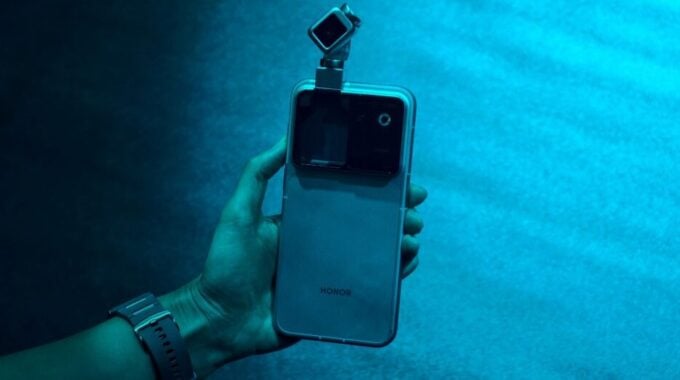
Most smartphone camera upgrades are about bigger sensors or smarter software. Honor went a different direction entirely. The Honor Robot Phone has a camera that physically moves inside the phone, and after making its debut at MWC 2026, it’s now an actual product you’ll be able to buy. As reported by GadgetMatch, Honor has officially launched the device, confirming its mechanical gimbal system, AI-powered controls, and a cinema imaging partnership with ARRI.
That’s a lot to unpack. So let’s get into it.
The gimbal inside the phone is the whole story
The Robot Phone’s standout feature is what Honor calls the Titanium Agile Gimbal, a 4DoF mechanical system built directly into the phone. It’s just 9.59mm thick and packed with over 100 precision components backed by over 100 patents. Honor says it shrank the gimbal’s volume by 65% compared to traditional gimbals while pushing structural strength up by 200%.
At the heart of it is a 2.6-gram titanium motor that can spin at up to 360 degrees per second. That’s not a software trick. That’s actual physical rotation, happening inside a smartphone. The camera can tilt, pan, and reposition itself without you ever touching it.
The practical payoff is real. The phone supports six camera movement modes:
- AI SpinShot (90 or 180-degree camera rolls)
- Default Stabilization
- Tilt Locked
- Super Steady
- FPV
- FPV Vertical
There are also three smart tracking modes, Gimbal Tracking, Subject Tracking, and Pre-Composition, designed to keep a subject in frame even when the phone or subject is moving. That’s the key difference between this and optical image stabilization. This camera doesn’t just correct for your mistakes. It actively moves to build the shot you want.
You can literally talk to the camera
Honor pairs all that moving hardware with a feature called YOYO Robot Mode. It combines voice commands, gesture recognition, and AI tracking so you can control the gimbal without touching the phone at all. Wake it up, deploy the gimbal with a flip gesture, and start giving directions. You can tell it to turn left by a specific angle, tilt up toward the sky, or rotate for a set amount of time.
For anyone who regularly shoots themselves, whether for vlogs, livestreams, or video calls, this is genuinely useful. The camera tracks you and keeps you in frame. You stop fussing with the phone. That’s the pitch, and it’s a reasonable one.
YOYO also connects to Honor’s broader agentic AI features, handling multi-step actions across apps and system settings. So it’s not just a camera trick bolted onto a basic phone.
ARRI color science on a smartphone
The Robot Phone is also the first product to come out of Honor’s Cinematic Imaging Partnership with ARRI, the company behind some of the most respected cinema cameras in the world. That partnership brings 10-bit ARRI LogC3 recording, ARRI Wide Gamut 3 support, and ARRI Looks to the phone’s camera system.
Honor says the imaging pipeline processes data in 14-bit 4:4:4 before outputting 10-bit LogC3 and 4:2:2 video, with up to 14 stops of dynamic range and an 8dB improvement in signal-to-noise ratio through AI noise reduction. The footage is designed to drop straight into DaVinci Resolve, where you can apply ARRI LUTs as part of a proper edit workflow.
Is this for everyone? No. But for creators who actually shoot and grade their footage, having a phone that produces files compatible with professional cinema workflows is a big deal. It matters more than another megapixel count bump.
Pricing and availability
Honor says the Robot Phone will launch in China first, available in Grey and Silver. Final pricing and availability details are still to come, but the product is real and heading to market. Whether it makes it to international markets and at what cost is still an open question.
Still, the direction is clear. Honor is making a serious bet that creators want more from their phone camera than just a bigger sensor. A camera that can move itself, respond to voice, and produce footage ready for professional color grading is a bold swing. Whether the execution holds up in real-world use is what we’re really waiting to find out.