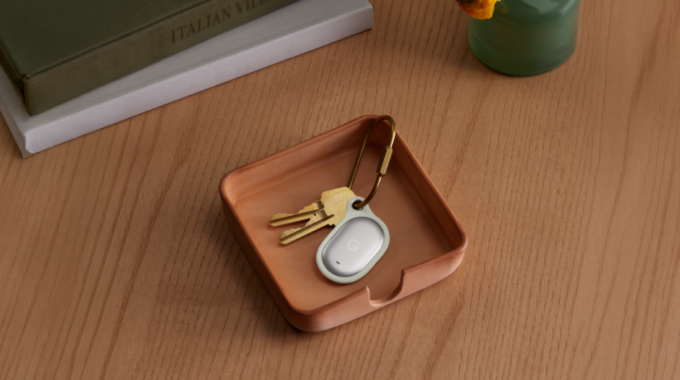
Apple has owned the tracker tag space for years. Tile tried. Samsung gave it a shot. And now Google is finally throwing its own hardware into the ring. The company announced the Google Pixel Tag on August 12, and honestly, the specs make a pretty strong first impression.
What the Pixel Tag actually is
It’s Google’s first-ever finder tag, designed to attach to your keys, wallet, luggage, or anything else you’re constantly losing. At $29 for a single tag or $99 for a four-pack, it slots in right alongside the AirTag on price. The body is stainless steel, rated IP67 for water and dust resistance, and Google says it’s built to resist flexing and cracking. So it should survive being stuffed in a bag or dropped in a puddle.
Battery life is rated at up to one year, and you can replace it yourself. That’s a small but genuinely useful detail. Nobody wants to trash a $29 tag because the battery died and the thing is sealed shut.
Setup and sharing
Setup is straightforward. Pull the battery tab, bring the tag close to any Android device running Android 9 or newer, and it pairs automatically through Fast Pair. From there, you name it inside the Find Hub app, either by picking a category or typing a custom label. You can also share a single Pixel Tag with up to 10 people, which is a smart move for households or families tracking shared items like a set of car keys.
Finding your stuff
This is where it gets interesting. Open Find Hub and your tagged items show up on a map. If you’re within Bluetooth range, you can ring the tag to find it. But Google also added Ultra-Wideband with Bluetooth Channel Sounding, which gives you visual distance and directional cues, basically pointing you right at the missing item. Think precision finding that can locate something stuffed under a couch cushion or buried in laundry.
And if the tag is completely out of range? Find Hub taps into a network of over one billion Android devices to help locate it. Location data is end-to-end encrypted, so your information stays private while the crowdsourced network does the heavy lifting. That’s a massive advantage Google has over smaller competitors.
A few other features worth knowing:
- Left Behind alerts notify you before you walk away from a tagged item
- There’s a button on the tag itself that rings your phone, so it works both ways
- You can locate and ring the tag from a Pixel Watch using the Find Hub app
- Pixel Buds users can ask Gemini to ring the tag hands-free
- Your phone automatically alerts you if an unknown Pixel Tag is traveling with you
Why this matters
Android users have never had a first-party tracker option from Google itself. AirTag works brilliantly inside Apple’s ecosystem, and the Pixel Tag is clearly Google’s answer to that. With a billion-device network behind it, tight integration with Pixel Watch and Pixel Buds, and a competitive price, this isn’t just a me-too product. It fills a real gap.
Still, Google has launched hardware before and quietly abandoned it. The real test is whether Find Hub and the tag’s software support stay consistent over time. But the foundation here looks solid.
The Google Pixel Tag goes on sale November 11 through the Google Store. Single units are $29, and the four-pack runs $99.