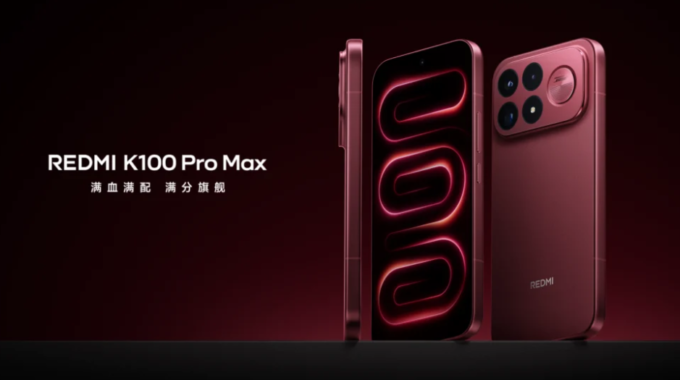
Not every phone launch is a clean sweep, and the Redmi K100 Pro series is proof of that. Early sales data out of China shows the new lineup sitting at roughly 95% of the K90 series’ first-week numbers. That sounds like a miss. But zoom in on the individual models, and there’s a very different story hiding in there.
According to Gizmochina, digital blogger @RDObservation, who closely tracks the Chinese smartphone market, shared the breakdown covering launch night plus the following seven days. The standard Redmi K100 Pro only hit about 70% of the K90’s sales from the same period. That’s a notable step back. But the K100 Pro Max? It reached 135% of what the K90 Pro Max sold. That’s a big deal.
And this tracks with what Xiaomi Group Partner and President Lu Weibing had already posted on August 12. He said the K100 Pro Max’s first-day sales hit 150% of its predecessor’s figure, based on data up to midnight on launch day. So the Pro Max was already running hot right out of the gate, and it held that momentum through the first week.
The two phones launched officially on the evening of August 11. Here’s what separates them:
- Redmi K100 Pro: Snapdragon 8 Elite Gen 5 V chip, 8,580mAh battery, Bose-tuned speakers
- Redmi K100 Pro Max: Snapdragon 8 Elite Gen 5 chip, 9,070mAh battery, Bose-tuned speakers
After subsidies, the series starts at 3,199 yuan, which works out to roughly 412 euros. For a flagship with those specs, that’s aggressive pricing by any standard. The battery sizes alone are worth talking about. Nearly 9,100mAh in a phone is not subtle, and Xiaomi clearly isn’t apologizing for going big.
So why does the Pro Max’s performance matter more than the overall series number? Because it tells you where buyer interest is concentrated. People aren’t just picking up any K100 phone. They’re specifically reaching for the top config, the one with the stronger chip and the massive battery. That’s a healthy sign for Xiaomi’s premium positioning in a market where mid-range phones keep getting better and pulling budget away from flagships.
The regular K100 Pro’s softer numbers are worth watching, though. Coming in at 70% of its predecessor’s first-week sales is the kind of thing that could push Xiaomi to re-examine how it differentiates the standard model from the Max. Right now, the gap in chip performance and battery size is real, and buyers clearly feel it.
Absolute unit numbers still haven’t been shared publicly, so all of this is relative. But the direction is clear. If you’re wondering which phone Xiaomi should be most proud of right now, it’s the Pro Max. And if you’re a buyer sitting on the fence between the two, the market is basically telling you the same thing.