Two hundred megapixels. On a telephoto camera. That’s the number Vivo is leading with for the X500 Pro Max, and honestly, it’s hard not to pay attention. According to Gizmochina, the brand’s product manager has been steadily dropping camera specs ahead of the X500 series’ September launch in China, and the latest round of posters confirms the periscope telephoto details for both the X500 Pro and X500 Pro Max.
The X500 Pro Max gets a 200MP Zeiss APO super telephoto camera built around a 1/1.4-inch BluePrint and Samsung HP0 sensor, the same combination found in the Vivo X300 Ultra. That’s a big sensor for a telephoto, and it matters because a high-resolution setup like this can support two stages of lossless zoom without turning your photos into smeared watercolors. Vivo is also adding hardware-based 4x ISZ technology, which essentially means you’re getting serious optical reach without the usual quality tradeoffs.
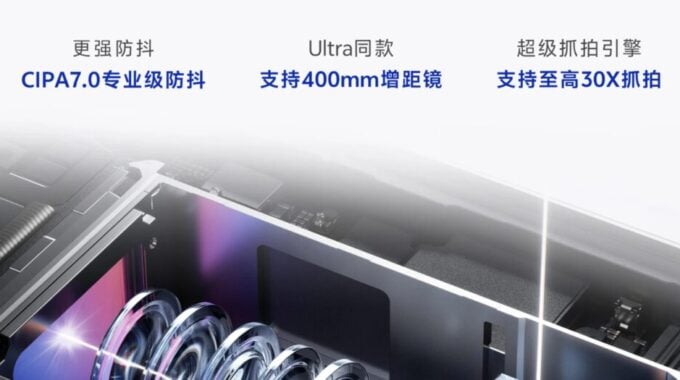
And it gets more specific than that. The system pairs with a 400mm telephoto extender, targeting exactly the kind of shooting scenarios where phones normally fall apart, birds in flight, performers on a stadium stage, fast-moving sports action. Vivo is backing the hardware with CIPA 7.0-rated stabilization and a Super Capture Engine that supports up to 30x capture. The pitch is that it can freeze a fast-moving moment cleanly. That’s a bold claim, but the specs at least give it a credible foundation.
The X500 Pro takes a different path. It carries a newly designed 85mm Zeiss 64MP APO super telephoto camera using a Sony LYTIA 610 sensor with an unusual GG 1×1 and RB 2×2 pixel structure. The idea is that this hybrid arrangement gets you the resolution benefits of a tight 1×1 pixel layout while keeping the fast focusing advantages of a 2×2 setup. Vivo says this is a direct evolution of the APO technology in the X100 Pro, but redesigned to work within tighter physical constraints.
The 85mm focal length also gives the X500 Pro more flexibility than a longer fixed focal length would. You’re getting the full 64MP for detail, plus room to crop further in post. On the video side, it supports 4K 120fps slow-motion, 4K 60fps HDR output, improved telephoto autofocus, and CIPA 7.0 stabilization. That’s a strong feature list for a phone that isn’t even the top model in the lineup.
What makes this worth watching isn’t just the specs in isolation. Telephoto has quietly become the most competitive category in flagship smartphone cameras. Apple, Samsung, Xiaomi, and Huawei have all been pushing longer focal lengths and higher sensor quality over the past two years. Vivo going this deep on two separate telephoto systems, one chasing raw resolution and one chasing optical quality, suggests the brand is trying to own this space rather than just participate in it.
No global pricing or availability has been confirmed yet, but with a China launch expected in September, full details shouldn’t be far off. The real question is whether the real-world results match the spec sheet. Megapixels and sensor sizes are easy to put on a poster. Actually delivering sharp, stable, usable zoom shots at 30x is a different story entirely.