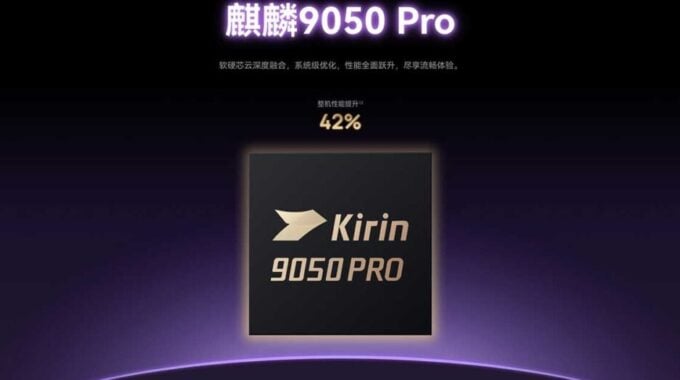
A 7nm chip beating a 3nm chip shouldn’t be possible. And yet, here we are. Bernstein Research has found that Huawei’s new Kirin 9050 Pro outperforms Apple’s A17 Pro in performance tests, and that’s a result nobody saw coming.
According to Huawei Central, the findings come from Bernstein Research, a firm that tracks semiconductor performance across the industry. The Kirin 9050 Pro debuted earlier this month inside the Huawei Mate XT, and analysts wasted no time putting it through its paces against the best chips Apple has to offer. The A17 Pro is built on TSMC’s 3nm process and powers the iPhone 15 Pro lineup. It has been widely considered one of the most capable mobile processors on the market. So beating it, even on some benchmarks, is a serious statement.
What makes this so wild is the process node gap. In chip design, smaller nanometers generally mean better efficiency and more transistor density. Apple’s 3nm chip should, in theory, have a significant structural advantage over a 7nm design. But Huawei’s engineers appear to have closed a lot of that gap through architectural improvements and software-level optimization. That’s not a small achievement. That’s years of focused engineering work paying off in a very public way.
Context matters here. Huawei has been operating under US trade sanctions that cut off access to advanced chip manufacturing. The company can’t use TSMC or other leading-edge fabs for its most advanced designs. So the fact that it’s competing at this level while working with older process technology says a lot about where Huawei’s silicon ambitions are headed. This isn’t a company that’s standing still.
For consumers, this matters beyond brand loyalty or geopolitics. It signals that chip performance is no longer a story where only the smallest node wins. Efficiency, architecture, and optimization are just as important. And for Apple, it means competition in the high-end silicon space is heating up in ways the company probably didn’t expect from Huawei in 2024.
The Kirin 9050 Pro is a reminder that writing off any chip maker based on manufacturing constraints alone is a mistake.