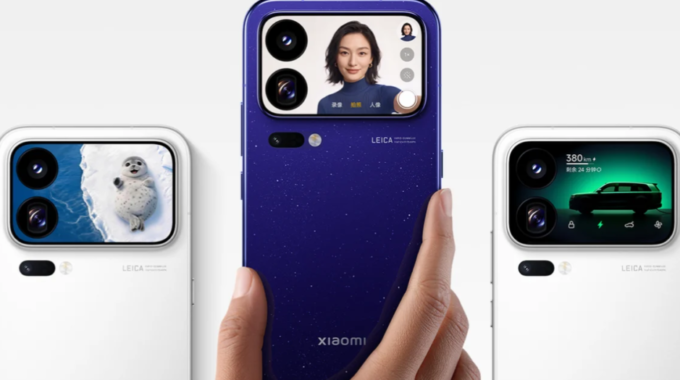
A secondary display on the back of a phone sounds like a gimmick. And sometimes it is. But Xiaomi is making a real case for the idea with the 18 Pro and 18 Pro Max, which were just launched in China. These aren’t novelty screens. They run at 120Hz, hit 4,000 nits of brightness, and support over 100 app cards at launch. That’s not a party trick. That’s a second phone glued to the back of your first one.
Two chips, two screen sizes, one shared DNA
The 18 Pro runs on Qualcomm’s 2nm Snapdragon 8 Elite Gen 6, with the chip’s Oryon CPU topping out at 5GHz. The Pro Max gets the Snapdragon 8 Elite Extreme Gen 6, the beefier variant of the same architecture. Both are serious silicon. The difference comes down to peak performance headroom, which will matter most to gamers and heavy multitaskers.
On the front, the displays follow the standard flagship formula. But it’s the back panels that separate these phones from the crowd. The 18 Pro has a 2.7-inch OLED rear display and the Pro Max bumps that up to 2.9 inches. Both panels are sharp, bright, and fast. You can check notifications, run mini-games, or pull up AI-generated custom cards without flipping the phone over. That’s actually useful, not just impressive at a trade show.
The camera setup Leica fans will love
Xiaomi has leaned hard into its Leica partnership again. The main shooter is a 200MP sensor, which is about as high as smartphone cameras go right now. The Leica branding isn’t just a badge, Xiaomi has consistently used it to push color science and lens tuning in a direction that feels more considered than most Android rivals. Whether 200MP is overkill for your needs is a fair question, but the option is there.
Software, AI, and privacy built in
Both phones ship with HyperOS 4 and what Xiaomi calls Alive Design, its updated interface. The bigger software story is Super XiaoAI 2.0, the AI assistant powered by Xiaomi’s own MiMo large language model. It handles memory, smart home controls, travel planning, and cross-device tasks across phones, tablets, Windows PCs, and Macs. Think of it as Xiaomi’s answer to Apple Intelligence, and honestly, the cross-device scope sounds ambitious.
There’s also a dedicated AI button on both phones, which gives quick access to voice notes, mute mode, privacy controls, and the XiaoAI assistant. The hardware privacy feature is worth flagging. It limits side-angle viewing and can automatically protect sensitive apps. That’s a real feature for people who care about screen privacy in public spaces, not just a settings menu checkbox.
Specs worth knowing at a glance
- Processors: Snapdragon 8 Elite Gen 6 (Pro) and Snapdragon 8 Elite Extreme Gen 6 (Pro Max)
- Rear displays: 2.7-inch OLED on Pro, 2.9-inch OLED on Pro Max, both at 120Hz and 4,000 nits
- Main camera: 200MP with Leica tuning
- Connectivity: 5G-A, UWB, Wi-Fi, Bluetooth, NFC, UWB digital car keys
- Speakers: Dolby Atmos stereo on Pro, three-speaker setup on Pro Max
- Protection: IP66, IP68, and IP69 rated
- Software: HyperOS 4 with Super XiaoAI 2.0
Price and availability
The 18 Pro starts at 5,999 yuan (around $895) for the 12GB/256GB model and goes up to 8,999 yuan ($1,343) for 16GB/1TB. The Pro Max opens at 6,999 yuan ($1,045) and tops out at 9,999 yuan ($1,492) for the fully loaded version. Both phones are available in Black, White, Ice Peach Pink, Galaxy Blue, and a transparent edition. Sales kicked off immediately after the launch event in China.
Global availability hasn’t been confirmed yet. But Xiaomi has been expanding its international flagship push steadily, so don’t rule it out. If these do make it outside China, they’ll land in a market where Samsung and Apple dominate. The rear display and the aggressive pricing at the top end will be the story. And that might be enough to get people to look twice.