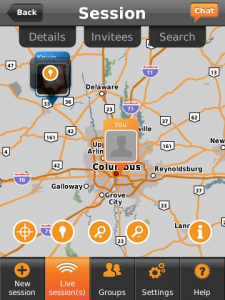
YellowPin has recently launched a simple social networking tool that lets your Facebook friends know where you are when you update via mobile. It explicitly doesn’t work with GPS, so folks only transmit their location when they want to, and aren’t perpetually checking over their shoulder for stalkers. It works by sending SMS commands like “pl valley view center, dallas, tx.” to 555888, which then updates your location for friends to see. Facebook is a solid start, and it’s entirely likely that YellowPin will spread out to other application-capable social networks in due time (Twitter, maybe?). Not a bad little service, and it only costs a dollar each month. Interested? Go ahead and take a look.
Google had enabled voice search in the Maps application awhile back, and now the feature has found its way to the Google (NSDQ: GOOG) Mobile App for BlackBerry (NSDQ: RIMM). On top of voice-activation, the latest update to the Google Mobile App is My Location integration, so your search results are pertinent to where you are. My Location was a cell tower ID system implemented in Google Maps Mobile a little over a year ago, and provided a lot of handsets without integrated GPS some location-based services they wouldn’t otherwise have access to. I usually use Vlingo for quick Google searches by voice, and will probably stick with it since it’s just so danged convenient to have one dedicated shortcut key and not have to launch the app separately to use it. Still, these are solid additions to Google’s already great mobile app, and with any luck, the changes will find their way to the recently-launched Windows Mobile version soon.
GeoSpot is taking a simple, useful twist on your old-fashioned location-based service: in addition to your usual local search, these guys are taking into account business hours, so your results can show only what’s open during a designated time. It’s a very clever addition, and considering some of the Palm (NSDQ: PALM) Pre’s similar GPS/calendar features, we’ll start seeing more location/time cross-referencing features in mobile. You can access www.geospot.com in your mobile web browser – no app needed, although a dedicated app that could plug into GPS data would be pretty danged handy. It sounds like GeoSpot has catalogued the hours of many establishments across America, so fire up your mobile browser and see if that chinese place around the block is open. Next step? Ordering by SMS.
The My Location upgrade was nice, but adding pictures right from the street to your mobile maps is even better. Street View has been included in the latest build of Mobile Maps for BlackBerry (NSDQ: RIMM) and Java-enabled phones, so head on over to mobile.google.com to get started. One thing that bugs me a little bit is that the new Google Mobile App doesn’t include the old Google Mobile Updater, which automatically detects when new versions of Google (NSDQ: GOOG) software like this come in. What I would really like to see is a user-driven Street View where you could take pictures on your mobile and have them uploaded to the Google Mothership, get them approved, and put them into Street View. Call me a dreamer.
Oh yeah, there’s walking directions, too! A nice addition to transit directions! There’s also business reviews, which can prove to be a great early-warning system for avoiding bad seafood or other restaurant-based dangers.
By Simon Sage on Wednesday, September 17th, 2008 at 7:00 AM PST In LBS
Google Maps had released a handy feature for mobile apps last year which would detect the cell tower you were using in order to figure out your general area, though it wasn’t quite as precise as honest-to-goodness GPS. Well, Google has recently found a way to determine a cell tower’s coverage area, and will be incorporating that info into the My Location feature. If you’re in a densely populated area, you’re probably using a smaller cell tower, and so your location is within a smaller radius, making it easier for Google-powered mobile mapping apps to zero in on your location more accurately, even if your device doesn’t have a GPS unit. For folks in more rural areas, they’ve tweaked the centering system so that it will move to the closest city rather than cell tower (since it might be a ways outside of town). Cool stuff all around, and offers a lot to folks with more down-to-earth cell phones.
Windows Live Search has been running their standalone voice-activated search and location app on BlackBerry since mid-July, but it looks like that partnership is going to deepen further, as RIM has announced that Windows Live Search will be powering local search within the BlackBerry (NSDQ: RIMM) Maps application, as well as being built into the Browser (presumably as an option from the home screen’s drop-down menu, right beside Google (NSDQ: GOOG), Wikipedia, and Dictionary.com). While the Browser integration isn’t that big of a deal, being built into the native GPS app is pretty huge, especially considering the close relationship RIM has had with Google lately. Right now the Yellow Pages handles local search on BlackBerry, which are going to be some pretty big shoes to fill, unless Microsoft (NSDQ: MSFT) can somehow integrate the same search results with their own. A big OS patch is rumored to be coming out this month, which could be when we see the updated software.
A mobile phone service that lets users track the location of friends and family is launching in the UK. The Sniff application sends users a message showing the position of the person they are trying to find – who must also have signed up to the service – and a map.
The sign-up procedure is to register the user’s phone via text to a shortcode, and additionally users can also add a Facebook app (like with everything it seems these days!). For Only users over 18 are accepted in to the service.
Once signed up, users can then sniff to find the location of a friend, and will get a reply showing a map and their location. Fortunately the service is enabled across all UK MNOs, so there isn’t an issue with your mates being on a different network to you.
Right now the service costs 50p per successful sniff (see below), but the thinking is that this could eventually become ad-funded (like with everything it seems these days!).
Well, sounds quite cool – wonder if there are some other upcomign mobile social networking services out there……?
According to MobiAD News, two stories that it has covered recently are indicating that Location-Based Advertising (LBA?) is becoming more of a reality – by the way, the companies involved in those stories are Skyhook Wireless, Loopt/CBS Mobile.
Skyhook Wireless have announced that they have introduced location based advertising to their software development kit. The development will allow mobile application creators to earn revenue from the ads that are delivered based on the user’s location. The service is different to many others as it uses wifi signals to locate a mobile phone. This is a novel way of locating a phone and is possible as the company has mapped wifi signals across 70% of the United States and 40 million access points worldwide. The ads are to be provided by Quattro Wireless.
CBS Mobile has agreeed a deal with Loopt to provide targeted location based ads. This will add an extra level of targeting to ads on CBS properties, as ads will only appear when Loopt users visit one of CBS’ mobile sites. CBS will be able to tell the location of the user (via GPS) and will have the option of serving an ad for services in the nearby area.
So there you have it, different offerings that claim to deliver location-based Ads – neither of them using the Mobile network – of course, as we know, the Operators are all over Mobi Ads that do in some way make use of their networks, but the above does show that other channels are at least open.
Personally, I think the power to make this a cohesive offering is with those handset vendors (and suchlike) that have the scale and capability of operations to do so – Nokia (NYSE: NOK), Apple (NSDQ: AAPL), and Google (NSDQ: GOOG) all spring to mind…..! What say you, IntoMobile readers?
Navizon has released the free version of its popular no-GPS GPS software called Navizon Lite. The idea is to provide users with the same service Google (NSDQ: GOOG) Maps is now offering for free with their “My location” feature, to rely solely on Cellular positioning. As we already know, this isn’t the most accurate method of positioning, hence users are provided with an accuracy of approximately 1500 meters (1 mile).
To additionally sweeten the free deal and to hook up users to their more advanced version, Navizon Lite also includes a 15 day trial of its more accurate Premium version (accuracy of up to 10-30m), which also includes WiFi positioning and Trail function. Navizon Lite is available for the iPhone, Windows Mobile, Symbian/Nokia (NYSE: NOK) and Blackberry (NSDQ: RIMM) devices and is selling for $24.99.
MobiMate announced that its popular travel application, WorldMate Professional, is now available free of charge to users of the Symbian UIQ 3.x and Windows Mobile Standard based devices. Initially, we saw MobiMate testing its “Freemium business model” with the release of WorldMate for Symbian S60 based devices. Apparently, the test proved as a success and now they’re expanding their offering to other platforms.
WorldMate for the Symbian UIQ platform supports Sony Ericsson (NYSE: SNE)’s M600, P990, W950, P1 and W960 smartphones, as well as Motorola (NYSE: MOT)’s MOTORIZR Z8. Free services include world clocks, global weather, measurements, day/night map, currency converter and clothing size converter. Additional services offered for a paid subscription include flight status, flight schedule, area codes and an interactive packing list for $6.95 a month or $69.95 a year. The application for Windows Mobile smartphones supports Motorola’s MOTO Q and HTC Vox and features clocks, weather, measurements, world map, currency converter and clothing size converter at no cost to users. Premium-tier memberships are provided at $3.95 a month or $39.95 a year, and include flight status and weather satellite imagery.