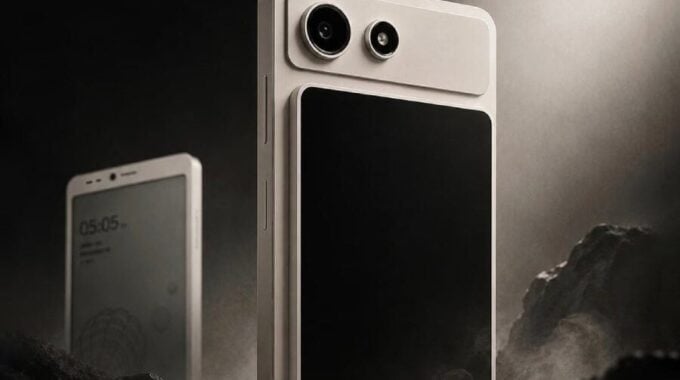
Most phones make you pick one kind of screen. Hisense thinks you should have two. The company has started teasing its new A10 in China, an e-ink phone with a twist: a magnetically detachable color LCD panel that clips onto the back when you need it and comes off when you don’t.
The idea is simple. E-ink screens are great for reading, note-taking, and anything that requires long, comfortable screen time. They use very little power and are easy on the eyes. But they struggle with color, video, and anything that moves fast. The A10 tries to solve that problem without forcing users to give up either experience.
This kind of dual-screen thinking is rare but not completely new. BigMe tried something similar with its HiBreak Dual, which also pairs an e-ink front panel with a secondary color screen. The key difference with the Hisense A10 is that the color panel is fully removable rather than fixed to the back. That means users can leave it at home when they just want a quiet reading device and attach it again when they need to browse social apps or look at photos and comics in color.
The front of the A10 is a 6.13-inch e-ink display designed to look and feel like paper. That puts it in familiar territory for Hisense, which has been making e-ink phones for several years. The A9, launched back in 2022, had a 6.1-inch e-ink screen at 300 PPI and ran on a Snapdragon 662 chip. It was priced at 1,799 yuan and later got a refresh with more RAM and storage in 2025. The A10 is a clear step up from that.
On the inside, the specs are more modern than you might expect from a niche reading phone:
- 4nm octa-core Qualcomm chipset
- Android 16 out of the box
- 5G connectivity
- Wi-Fi 6 support
Pricing has not been confirmed yet, but the A10 is expected to launch at CNY 3,999, which works out to roughly $590. That is more than double what the A9 cost at launch, though the hardware and the detachable screen concept justify at least some of that jump.
The broader context here matters. E-ink phones have always been a small market, built for a specific kind of user: someone who reads a lot, wants long battery life, and doesn’t need a phone that doubles as a gaming device. The problem is that even those users occasionally need color. Hisense’s modular approach is one of the more practical answers to that problem the category has seen so far. Whether buyers are willing to pay $590 for it will say a lot about where e-ink phones can realistically go from here.