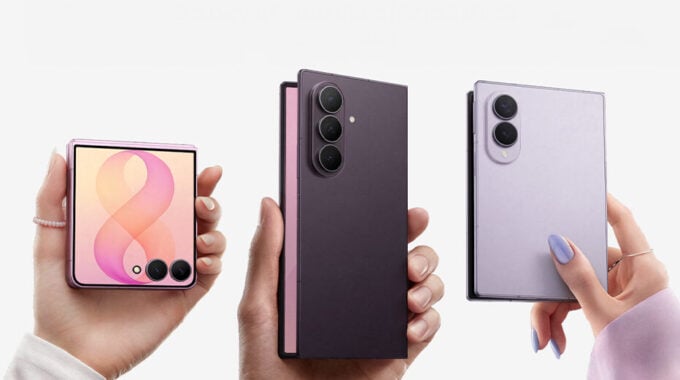
Samsung has just made its biggest push yet into the foldable phone market. The company announced three new devices at once: the Galaxy Z Fold8 Ultra, the Galaxy Z Fold8, and the Galaxy Z Flip8. Each one targets a different type of user, which is a notable shift from Samsung’s previous strategy of releasing one or two foldables at a time.
The move reflects how competitive the foldable segment has become. Rivals like Google and Motorola have been pushing into the space, and Chinese manufacturers have been shipping foldables in large numbers. Samsung is responding by widening its own range, giving buyers more reasons to choose a foldable over a traditional slab phone.
AI sits at the center of all three devices. Samsung has tuned its Galaxy AI software differently for each form factor, and has also built in access to Google’s Gemini. The goal is to make AI feel useful in the moment rather than something users have to go looking for.
The Galaxy Z Fold8: built around how people actually consume content
The Fold8 is the most interesting of the three from a design standpoint. Samsung has rethought the screen ratios to match the way people naturally shift between tasks throughout the day.
- The cover screen uses a 10:16 ratio, which feels familiar for quick tasks like messaging, checking social feeds, and watching short videos.
- The main display opens to a 4:3 ratio, which is better suited to games and films.
- Rotated sideways, that same 4:3 display becomes a comfortable reading surface for articles and e-books.
At 201g, this is Samsung’s lightest Galaxy Z Fold to date. It runs on Qualcomm’s Snapdragon 8 Elite Gen 5 Mobile Platform and carries a 4,800 mAh battery, which is larger than its predecessor. Samsung says the combination should keep users in whatever they are doing for longer without needing to reach for a charger.
A new technology called Flex Titanium sits inside the display structure. It combines a titanium-alloy film with an enhanced titanium plate to make the device thinner without sacrificing durability. Samsung says it also reduces crease visibility over time and makes the unfolding action feel smoother. The main display hits up to 3,000 nits of brightness and has a low-reflection finish for outdoor use.
On the camera side, the Fold8 has dual 50MP cameras covering wide and ultra-wide angles. A feature called My FanCam can automatically track a subject and reframe footage into a chosen aspect ratio, which is useful for sports events or concerts. Dual Recording lets users capture both the scene in front of them and their own reaction at the same time, using the cover screen as a viewfinder.
The Galaxy Z Fold8 Ultra: a serious productivity machine
The Fold8 Ultra is Samsung’s answer to the question of what an Ultra-tier foldable looks like. It has an 8-inch main display and measures just 4.1mm when unfolded, making it the slimmest Z Fold Samsung has ever made. It weighs 215g.
The camera system is the headline spec here:
- A 200MP main camera with High Dynamic Range support in 200MP mode, which should produce more accurate colors and better detail in high-contrast scenes.
- A new 50MP ultra-wide camera for wider shots, interiors, group photos, and macro photography.
The Fold8 Ultra is aimed at people who want to do serious creative work from a single device, whether that is shooting, editing, or sharing content. The larger screen gives more room for multitasking, and Samsung has tuned Galaxy AI to take advantage of that extra space with more connected and actionable tools.
The Galaxy Z Flip8: style and quick interaction on the go
Samsung describes the Flip8 as its sleekest flip phone yet, built for self-expression and fast interaction. The FlexWindow on the outside has been redesigned to surface AI-powered shortcuts and relevant information without needing to open the phone. Samsung says this makes it more practical as a daily driver for people who want the compact form factor but still need their phone to keep up with them.
Why this lineup matters
Foldables are still a small share of the overall smartphone market, but they are growing. By offering three devices at different price points and with genuinely different use cases, Samsung is trying to bring more people into the category rather than just upgrading existing foldable owners.
The emphasis on AI across all three devices also reflects where the industry is heading. TM Roh, Samsung’s Device eXperience Division chief, put it plainly: as AI becomes more capable of acting on a user’s behalf, the phone becomes the most personal way to access it. Samsung is betting that a foldable screen, with its extra surface area, is the best hardware for that future.
Pricing and availability details for the UK and other markets are expected to follow shortly after the July 22 announcement.