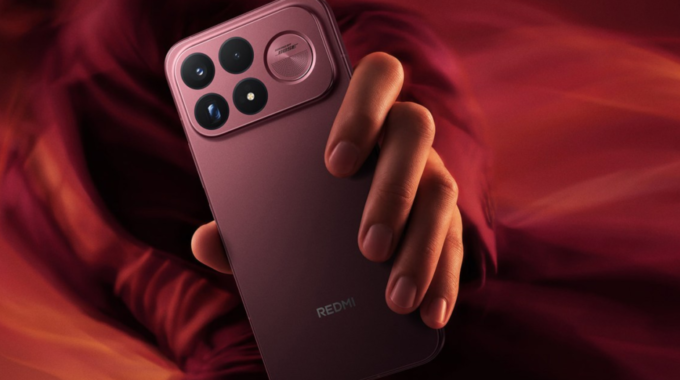
A 9,070mAh battery in a flagship smartphone. Let that sink in for a second. Xiaomi just launched the Redmi K100 Pro and K100 Pro Max in China, and while both phones have a lot going for them, it’s the battery capacity that makes your jaw drop first. These aren’t mid-range phones padding their specs sheet. They’re proper flagships, and they’re priced more aggressively than you’d expect.
The two phones share a lot of DNA, but the Pro Max pulls ahead in several key areas. Think bigger screen, better cameras, and yes, an even larger battery. So the question isn’t really whether these are good phones. It’s whether Xiaomi can get them out of China and into the hands of global buyers.
Two chips, one family
Here’s where things get slightly interesting. The Redmi K100 Pro Max runs on Qualcomm’s Snapdragon 8 Elite Gen 5, the full-fat version. The standard K100 Pro gets the V Series variant of the same chip, which has a slightly different GPU configuration and is essentially the cost-optimized cut of an already efficient processor. It’s not a huge deal in real-world use, but it’s worth knowing what you’re paying for. Still, both chips sit well above anything you’ll find in a mid-range device right now, so the performance gap between these two and the competition is wide.
Both phones come with up to 16GB of RAM and up to 512GB of storage, with the Pro Max pushing all the way to 1TB on the top configuration.
Displays that go beyond the usual 120Hz safe zone
Most phone makers are content to stop at 120Hz and call it a day. Xiaomi didn’t. Both the K100 Pro and K100 Pro Max ship with OLED panels running at 185Hz, which is genuinely unusual at any price point. The K100 Pro has a 6.56-inch screen with a 2,510 x 1,156 resolution. The Pro Max steps up to a 6.9-inch panel at 2,608 x 1,200. Both look sharp on paper, and that refresh rate should make scrolling and gaming feel noticeably fluid.
Where the Pro Max really pulls ahead: cameras
Both phones share a 200MP main camera on a 1/1.56-inch sensor. That’s a solid foundation. But the Pro Max builds a much more capable system around it.
- K100 Pro Max: 50MP periscope telephoto with 5x optical zoom
- K100 Pro: 2.5x telephoto camera
- K100 Pro Max: 50MP ultrawide camera
- K100 Pro: 8MP ultrawide camera
- Both: Bose-tuned rear subwoofer
That ultrawide gap is massive. Going from 8MP to 50MP is not a minor spec bump, it’s a completely different class of sensor. And a Bose-tuned subwoofer on the back? That’s an unusual move, but it could genuinely make a difference for media consumption. We’ll wait for hands-on testing before getting too excited, but it’s a differentiator you don’t see often.
The battery situation is kind of absurd (in the best way)
The K100 Pro packs an 8,580mAh silicon-carbon battery. The Pro Max goes to 9,070mAh. For context, most flagships in 2025 and 2026 have been sitting around 5,000 to 6,000mAh. So these numbers are in a different league entirely. Both phones support 100W wired charging and 50W wireless charging, so topping up shouldn’t take forever despite the massive capacity. For anyone who’s ever ended a long day at 8% battery, this series is basically designed for you.
Pricing and what comes next
The Redmi K100 Pro starts at CNY 3,699 (around $548) for the 12GB/256GB model. The K100 Pro Max starts at CNY 4,199 (around $622) for the same base configuration. Top-end storage options push the Pro Max to CNY 5,999 ($890) for the 16GB/1TB model. Color options include Volt, White, Black, and Red for the Pro, and Blue, White, Black, and Red for the Pro Max.
Right now, both phones are China-only. But Xiaomi has form here. The Redmi K90 Pro and K90 Pro Max became the Poco F8 Pro and F8 Ultra internationally. So there’s a reasonable chance the K100 Pro and Pro Max eventually show up globally as the Poco F9 Pro and Poco F9 Ultra. If that happens at competitive global pricing, these two will be very hard to ignore.