Five million. That’s the AnTuTu score Xiaomi is claiming for its brand-new Xring O3 chip, and if that number holds up in real-world testing, it’s a big deal. No mobile processor has crossed that threshold before. Qualcomm and MediaTek are going to feel this one.
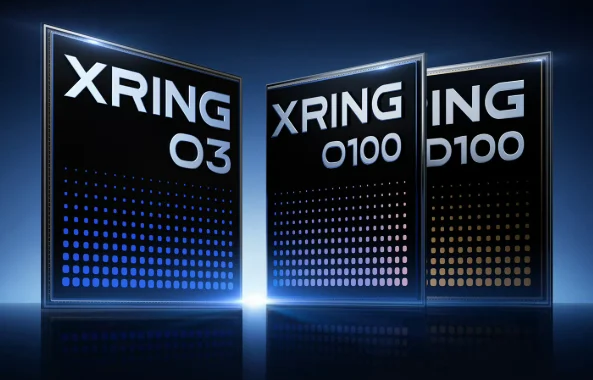
According to Gizmochina, Xiaomi didn’t just drop one chip. It dropped three. The Xring O3 is the flagship mobile SoC. The Xring O100 is purpose-built for AI workloads. And the Xring D100 is aimed squarely at smart cars and autonomous driving. That’s a full chip ecosystem, and it signals that Xiaomi is serious about owning its own silicon stack from top to bottom.
What the Xring O3 actually brings
Built on a 3nm process, the Xring O3 has a 10-core CPU with up to 60% better performance than its predecessor. The GPU is a 16-core G2-Ultra NX, which Xiaomi claims delivers 85% better graphics performance and 64% better power efficiency. Those are significant numbers, not small generational bumps.
The chip also supports LPDDR6 memory, a first for any Xiaomi mobile SoC. That gives it bandwidth of up to 113.8GB/s. For AI, the Xring O3 delivers 200 TOPS of tensor performance and 3.13 TFLOPS of vector performance. NPU performance is up 45% from before, and AI acceleration is spread across the CPU, GPU, ISP, DPU, and ADSP. Static latency is rated at 82ns. Xiaomi says it took 459 days to develop. That’s over a year of focused chip engineering, and you can see where the time went.
The Xiaomi 18 Fold is already taking preorders
The Xring O3 will power two upcoming devices: the Xiaomi 18 Fold and the Pad 9 Pro Max, both set to launch in China in September. Preorders for the 18 Fold are already open, and the device is expected to use a wide foldable form factor. So if you were waiting to see what a homegrown Xiaomi chip looks like in a flagship foldable, that answer is coming very soon.
Two more chips: one for AI, one for driving
The Xring O100 is built on a 6nm process with a near-memory AI architecture designed to cut down memory bottlenecks. It stacks chips and memory vertically using millions of high-speed channels to hit bandwidth of up to 1.22Tbps. That’s an absurd number, and Xiaomi plans to use it across phones, cars, and robots for on-device AI processing.
The Xring D100 is focused on intelligent driving. It’s Xiaomi’s first 3nm chip built for that use case, with a 20-core CPU and 16-core NPU. It supports up to 160GB of unified memory and can run AI models with up to 200 billion parameters locally, on the device, without cloud dependency. Development is done. Commercial availability is planned for 2027.
Why this matters beyond the benchmark
Benchmark scores are easy to be skeptical about. Companies control the conditions, optimize their software, and occasionally present numbers that don’t reflect what users actually experience day to day. So yes, treat that 5.22 million figure with some curiosity until independent reviewers get their hands on devices.
But the bigger story here isn’t just one score. Xiaomi now has chips for mobile, AI infrastructure, and autonomous vehicles. That’s a strategy, not a product launch. And in a world where Apple controls its own silicon and Google is building Tensor chips in-house, Xiaomi having this kind of vertical reach matters. It gives the company more control over performance, efficiency, and pricing in a way that third-party chip buyers simply don’t have.
- Xring O3: flagship mobile SoC, 3nm, 10-core CPU, LPDDR6, 5.22M AnTuTu
- Xring O100: AI chip, 6nm, near-memory architecture, 1.22Tbps bandwidth
- Xring D100: autonomous driving chip, 3nm, 20-core CPU, 200B parameter support, coming 2027
September is going to tell us a lot. When the Xiaomi 18 Fold actually ships and reviewers start running their own benchmarks, we’ll find out if the Xring O3 is as fast as Xiaomi says. But right now, the ambition is real and hard to ignore.