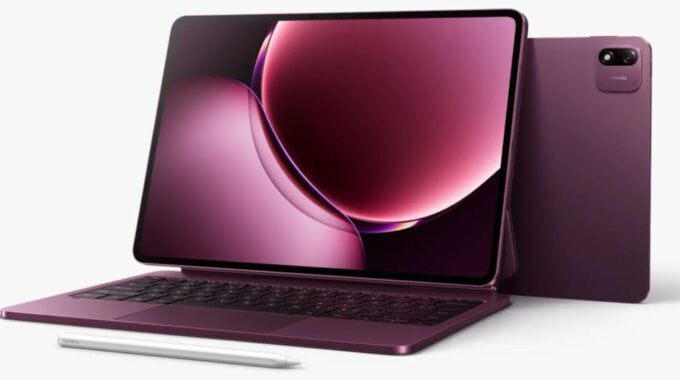
Xiaomi’s in-house chip story just got a lot more interesting. The company has confirmed the design and key specs of the Pad 9 Pro Max ahead of its China launch, and this isn’t just a bigger screen slapped onto last year’s formula. It’s Xiaomi making a real swing at the “tablet as PC” category, with its own silicon leading the charge.
A tablet built around Xiaomi’s own chip
The Pad 9 Pro Max will be the first Xiaomi tablet to run on the Xring O3, the company’s in-house flagship processor. That’s a big deal. The chip uses a 10-core all-big-core CPU setup clocked at up to 4.35GHz, which on paper is a serious number. But the GPU side is where things get genuinely exciting. The 16-core G2-Ultra NX GPU is claimed to deliver 85% better graphics performance than the previous generation while also cutting power consumption by 64%. Xiaomi says some benchmark results have already topped Apple’s A19 Pro. Take that with a grain of salt until real-world tests roll in, but even the conversation puts Xiaomi in territory it hasn’t occupied before.
Big screen, bigger ambitions
The display is 13.3 inches, making this the largest Xiaomi tablet to date. It uses an LCD panel, not OLED, which might disappoint some buyers at this price tier. Still, the size alone opens up a different kind of use case. Xiaomi is pitching this thing directly at productivity users, with support for PC-level applications built into the experience. A soft-light display variant is also expected to launch alongside the standard model, which suggests Xiaomi is thinking about eye comfort for long work sessions.
HyperOS 4 does the software heavy lifting
Hardware is only half the story here. The Pad 9 Pro Max will ship with HyperOS 4, and Xiaomi says it has specifically tuned the software for large-screen productivity. That kind of optimization matters more than people give it credit for. A fast chip running a phone-first interface is still a frustrating experience. If Xiaomi actually gets the software right, this tablet has a real shot at being a laptop replacement for a meaningful chunk of users.
Why this one matters
The Pad 9 Pro Max is launching alongside the Xiaomi 18 Fold in September, and together they signal something important about where Xiaomi is headed. Building your own chip is expensive and risky. But it also means Xiaomi controls the full stack, from processor to software, in a way that was never possible when it was entirely dependent on Qualcomm. The early benchmark numbers are encouraging. And if the Xring O3 delivers in daily use the way the specs suggest it could, Xiaomi just became a far more serious competitor in the premium tablet space. Pricing and global availability haven’t been confirmed yet, but here’s what we know is coming:
- 13.3-inch LCD display with a soft-light variant
- Xring O3 chip with a 10-core CPU at up to 4.35GHz
- 16-core G2-Ultra NX GPU with claimed 85% graphics performance uplift
- HyperOS 4 optimized for large-screen and productivity use
- Support for PC-level applications
So the specs are strong, the direction is clear, and the chip ambitions are real. Now Xiaomi just has to prove it all holds up outside a benchmark lab.