
Put this one under “crazy-awesome technology that will probably never leave the research/prototype stage”, but Stanford researchers have found away to apply carbon nanotubes in a thin, flexible, paintable film that is able to generate enough power to keep an LED going for ten minutes. Not much for mobile applications just yet, but it’s a start. We first saw this research last December, and now they’ve published their findings.
The research is mostly concerned with applying the battery to paper in order to power things like interactive packaging and RFID, but similar research has already been made with plastic (which you’re more likely to see in mobile phones). Though the power of the flexibility of the battery is really seen when it’s applied to paper, it does demonstrate how much punishment it could take even if it was applied to the outside of a mobile phone. As a point of comparison, Stanford’s paper battery is generating 108 mWh/g of energy density, versus 178 mWh/g in a standard BlackBerry Curve 8900 D-X1 battery (at least according to my bad math).
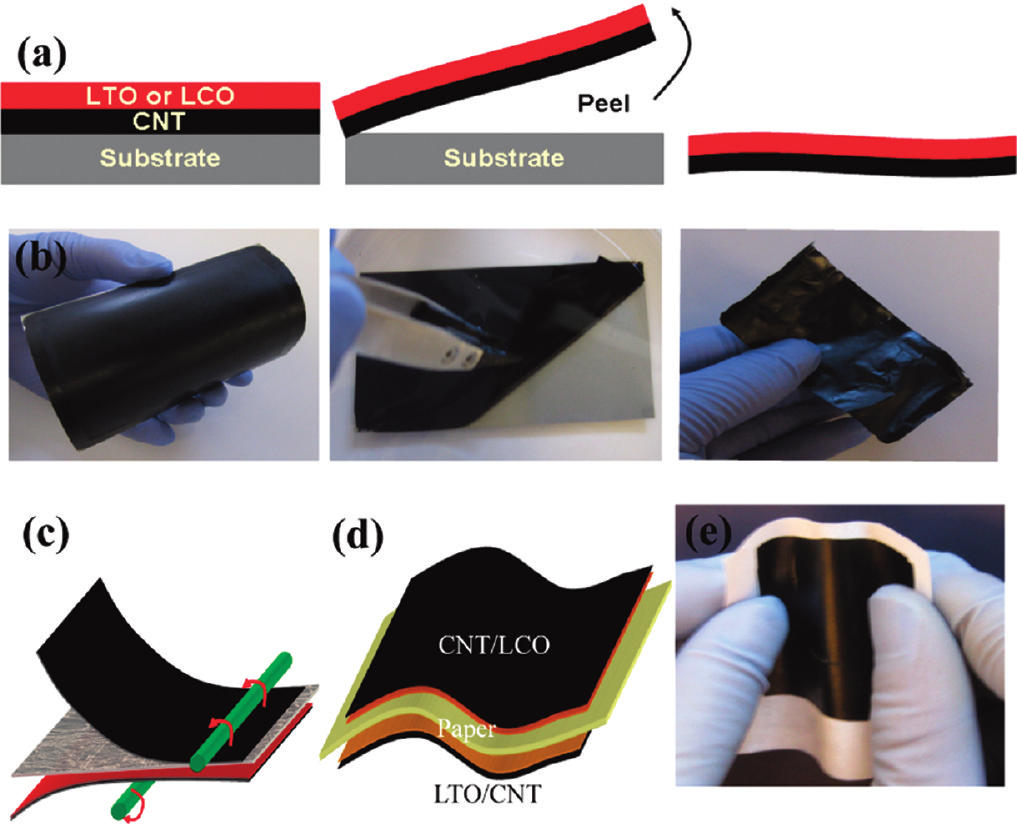
As far as production goes, the battery slurry isn’t applied directly to paper, but rather on a metal sheet, dried, then separated, and laminated onto the paper. It seems like even once applied to paper, its porous nature is still necessary to act as an efficient separator, meaning it could be tricky getting the same technology to work on something non-porous, like plastic. Still, the research shows those sheets can be stacked to create a cell unto themselves, likely in more flexible form factors than traditional batteries.

If you take a second to think about how much weight and space your standard lithium-ion battery takes up in a cell phone, the idea that comparable power could be attained with something wafer-thin (we’re talking 300 micrometers) is freaking sweet, and could either enable manufacturers to make even slimmer phones, pack more powerful hardware inside handsets, or get substantially more battery life with a secondary coat of this stuff on the outside of devices. Combined with strides being made in flexible display technology, paint-on solar panels, and the field day designers are having with concepts using the technology, it doesn’t seem entirely crazy to expect to have a flexible, bendy cell phone some time in the future. At very least, it will enable manufacturers to make phones in some much more interesting shapes.
All of that being said, I’m no engineer, and there are bound to be many caveats to Stanford’s paper battery that are beyond my expertise. If you’re interested in the full technical nitty-gritty, you can read the paper as a PDF over here. If any experts in the field have a take on this kind of thing, feel free to drop a comment.
[via Slashdot]