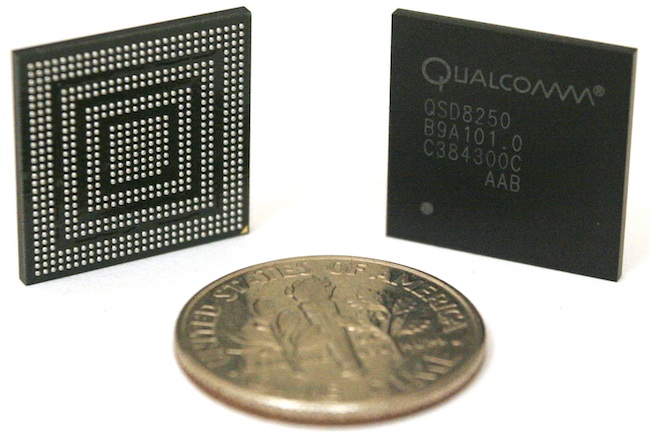
Qualcomm, maker of the chips that power over half the Android smartphones currently on the market, and every current and future Windows Phone, has just published their fiscal Q2 2011 financial results and to put it bluntly: they’re kicking ass and taking names. Revenues hit $3.88 billion, up 46% from the same quarter a year ago. Operating income was up 38%, hitting $1.07 billion, and profits were also up 29%, reaching $999 million. As of March 27 Qualcomm shut down their FloTV network, the poor attempt at creating a service that provides customers with over the air television, and they expect that once approval is given by the U.S. Federal Communications Commission they can sell the spectrum that FloTV occupied in the 700 MHz band for a cool $1.9 billion to AT&T. So how many actual chips did Qualcomm sell? Approximately 118 million of the MSM portfolio of products, the heart of many a mobile phone, which is up 47% year on year.
Looking ahead at the future Qualcomm’s success is only going to give them more share in the chips space. By taking all the components that are required to make a mobile phone and shoving them into a compact power efficient hardware platform that’s sold to handset makers, Qualcomm makes building smartphones seem like a walk in the park. When you consider how many new brands have entered the industry over the past few years and have emerged as big players, namely Huawei and ZTE, you can’t help but be in awe at what’s going on. The old duopoly used to be Intel chips running Microsoft’s operating system. Now it’s Qualcomm chips running Google’s operating system. Smartphone sales are only going to go up, especially with the dual core monsters slated to come out later this year. Those “superphones” will push down the cost of devices currently on the market, making them even more affordable for the masses.