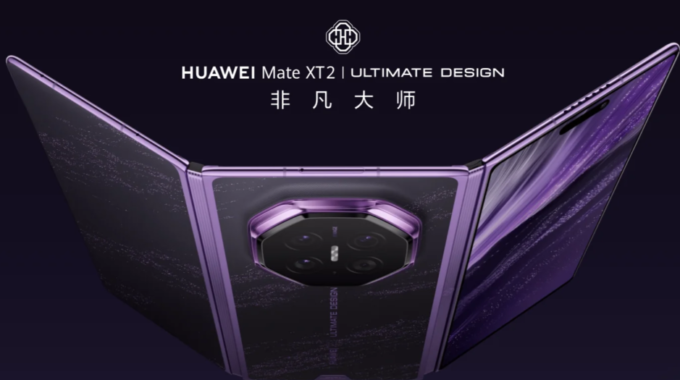
Three days. That’s how long it took Huawei to post official repair pricing for the Mate XT 2 after launch. And honestly? The numbers are almost as impressive as the phone itself, just not in a good way.
The Mate XT 2 only hit shelves on September 7, 2026, and Huawei has already revealed the full breakdown of spare part costs on their official site. This is a tri-fold phone, remember. Three screens, multiple hinges, engineering that makes most flagship hardware look simple. So yes, repairs were always going to cost something. But the actual figures are still a lot to process.
The displays are where things get brutal. A flexible screen main body on its own is 5,499 yuan, roughly $819. Opt for the privacy screen variant and that climbs to 6,499 yuan, around $968. Full screen assemblies, which include the screen, mid-frame, and battery, start at 7,999 yuan for the standard model and reach 8,999 yuan for the privacy version. There are discounted “special offer” assemblies with minor cosmetic marks starting at 6,999 yuan, but even those aren’t exactly casual money. The external screen is more manageable at 1,599 yuan, and a battery replacement sits at 499 yuan.
Smaller components are far more reasonable:
- Fingerprint sensor: 93 yuan (~$14)
- Battery cover: 399 yuan (~$60)
- Battery cover with camera lens: 1,399 yuan (~$208)
- Data cable: 129 yuan
- Protective film: 249 yuan
So what does all this actually mean? For most people, it’s a reminder that buying a device this complex comes with strings attached. Premium tri-folds push the limits of what’s physically possible inside a smartphone, but that engineering doesn’t come cheap to fix when something goes wrong. Out-of-warranty screen damage on the Mate XT 2 could cost you close to $1,000 before you’ve even looked at labor charges.
This fits a broader pattern in the foldable market. Repair costs have always been a quiet pain point for foldables, and as the category gets more ambitious, that problem scales with it. Huawei being upfront about the pricing is actually a good thing. But it does raise the question of whether buyers are fully prepared for the long-term commitment that comes with owning hardware this advanced. An extended service plan suddenly sounds a lot less optional.