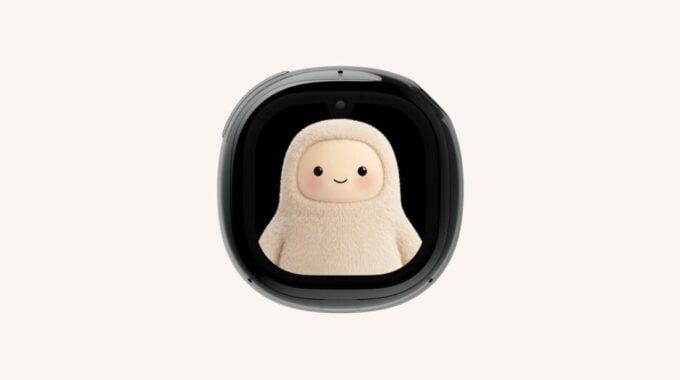
A Tamagotchi. Meta just put its AI inside something that looks like a Tamagotchi. That’s the sentence I never expected to write in 2026, but here we are.
At its annual Connect event, Mark Zuckerberg announced the ‘Muse Charm’, a small keychain device housing the company’s Muse AI. During the live demo, Zuckerberg showed how tapping the fingerprint sensor in the corner kicks off a conversation with Muse. The screen shows a small animated avatar as the face of the AI, and the whole thing is designed to clip onto your keys and go wherever you go. His words: Meta ‘packed the whole Muse experience, including the real-time voice and avatar stack into something that fits on a keychain and is always available to talk to.’
So why does this matter? Because it signals something bigger than a quirky gadget. The AI hardware race is heating up fast. After the mixed reception to devices like the Humane AI Pin and the Rabbit R1, a lot of people wrote off standalone AI hardware as a dead-end idea. Meta is clearly betting otherwise. Putting Muse inside a small, familiar, low-pressure form factor like a charm or keychain is a smart psychological move. It’s less intimidating than a screenless pin on your chest. It’s personal. It’s almost cute.
That said, the details are thin right now. Meta admits it has only built a few units, and the components and design aren’t even finalized yet. Still, the holiday timeline is locked in. Meta is pushing to have this ready to ship by December, which is an aggressive schedule for a product that’s barely off the drawing board.
There are real questions worth asking here. Battery life on something this small? Audio quality for real-time voice? How much does Muse actually know when it’s running through a keychain chip versus a server? Zuckerberg didn’t touch any of that at Connect, promising more details soon. That’s the part where I pump the brakes slightly.
But the concept is genuinely interesting. Wearable AI in a form that isn’t trying too hard. If Meta can pull off the execution, the Muse Charm could be one of the more compelling AI gadgets we’ve seen. Big ‘if’, though.