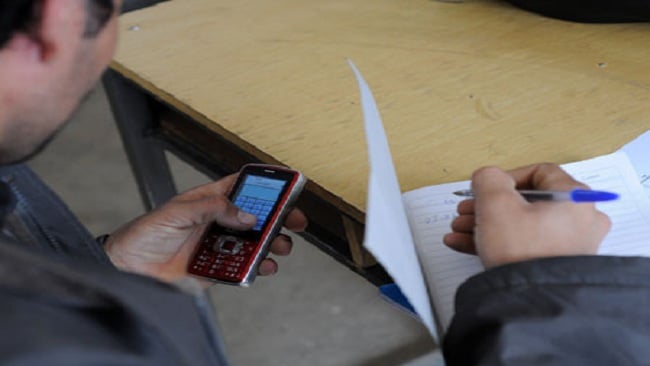
The mobile revolution has already changed the way many of us work, play and communicate but smartphones, apps and mobile technology also have the ability to make a strong impact on all levels of education. We’re definitely just at the tip of the iceberg and there are real challenges but mobile tech can soon be a valuable tool for educators and students.
Every once in a while, you’ll hear about a school giving its students free iPads or iPhones to assist in the learning process and these seem like cute stories. I honestly don’t know if having an iPad in a kindergartners’ hands assists in learning but I definitely see the value in giving a medical student an iPhone or some other type of smartphone.
In order to understand the impact smartphones and apps can have on students, it’s important to understand how students actually use these devices. Sprint is teaming with Notre Dame University for a comprehensive three-year study on the mobile habits of college students. Sprint will be providing 200 students with free smartphones (probably the Epic 4G) and two years of service in an attempt to try and understand how students use these devices.
The goal, said Sprint’s Candace Johnson, is to better understand the social networking habits, app usage and location data from these users to better tailor content for this demographic. Things move so quickly nowadays that an incoming freshman class may use their devices in different ways than those enrolled just a few years ago. There are financial goals of course – Sprint will be sponsoring Notre Dame athletics – but this could also help the university to figure out what roles apps and smartphones could play in course formation.Hardware and services are important but the software and content
“Apps have a significant potential for learning, we haven’t even scratched the surface,” said Angelo Biasi, founder of SMART Marketing Solutions and professor at New York University.
Biasi said mLearning could be crucial in corporate learning settings but the value for educational institutions can’t be understated. Just imagine an app which includes supplemental teaching materials and quizzes that a student can use while on a train or bus home. Instead of using those idle minutes playing Angry Birds or just playing around on Facebook, a student could get in a few minutes of additional learning. The notification capability also makes it easier to notify students if a class has been canceled or moved.
Biasi is putting this theory to practice, as NYU has teamed with GetJar to release an app for his mobile marketing class for small and medium-sized businesses. The coursework will be delivered via the web and through a cross-platform mobile app that was developed by Didmo and distributed by GetJar. The program will include course material, will enable Biasi to quiz students and it has even attracted interest from many people around the world, thanks to the reach of GetJar.
It’s easier to focus on colleges, as cell phone and smartphone usage is generally higher but there is value in bringing this down to lower levels of education like high school and maybe even grade school. We’re just seeing baby steps in using mobile technology in education but even the most bullish mobile app fans won’t say there aren’t challenges. Much like online learning was met with hesitation ten years ago, it can be tough to convince some school boards that mobile initiatives provide demonstrated value to students. It’s also difficult to try and reach students who have multiple phones running different operating systems or those without a smartphone.Patrick Mork, chief marketing officer at GetJar and soon to be at Google, said that not all classes may be perfect for mobile phones. For instance, a class where you practice art may be difficult to achieve on a small screen while literature or math classes might work better on a phone.
“Kids are going to be playing around with these phones anyways, so there’s a lot of opportunity to leverage that device and make sure that the learning material is engaging,” said Mork.
There’s also the very real problem of socio-economic disparities, as upper-crust universities may be able to afford giving students phones or creating apps but it’s difficult seeing schools with less resources being able to do that. Smartphone bills can cost more than $80 a month and that is far more than many parents can pay for their kids, especially if the educational increase is just marginal at this point. Multi-platform mobile content creation tools like Didmo can help to overcome some of that but there is still going to be a disparity.
No one is saying that mobile technology is going to be the panacea for education in the United States, as there are a multitude of issues which need to be addressed to enable the country to better prepare its students for the world. Overlooking the role mobile technology can play in the educational process will only create more problems.
[Photo credits: bjmcdonald, Ed Yourdon]
Related Phones
The Samsung Epic 4G is a variant of the Galaxy S Pro for Sprint. It's a CDMA-based device that also supports WiMAX. Features include a 4-inch WVGA Super AMOLED touchscreen, side-sliding QWERTY keyboard,… Read More »
The phone that changed everything thanks to its unique easy to use UI, capacitive touchscreen, and Apple's brand. Initially, Apple supported web-based apps only, but later has allowed native apps, this… Read More »
The iPhone 4 is the thinnest smartphone ever with all-new design, FaceTime video calling, Apple's stunning new Retina display, 5 megapixel camera and HD video recording. Read More »
-
tracy
-
http://www.facebook.com/people/Jessica-F-Smothers/1774336687 Jessica F Smothers
-
-
http://www.facebook.com/people/Chris-Taylor/605492360 Chris Taylor
-
Cheryl W.
-
http://www.facebook.com/people/Brianna-Swales/100001830519118 Brianna Swales
-
Anonymous
-
Anonymous
-
Anonymous
-
Edwin
-
Edwin
-
George
-
Anonymous
-
Zain Muzammil
-
Mihir
-
http://www.facebook.com/profile.php?id=100001235596936 Jason Wilkinson
-
Anonymous
-
Jennifer Evancho
-
http://www.facebook.com/mstavros2 Michael Stavros
-
Anonymous
-
http://twitter.com/fortunzfavor David Marseilles
-
http://twitter.com/scabbard1 Dennis Moore
-
Mmccarth
-
http://www.facebook.com/profile.php?id=1076201167 Paul Licke
-
http://twitter.com/Adam_Linke Adam Linke
-
http://twitter.com/mitchssssssss Mitch
-
http://www.facebook.com/people/Dustin-Carney/1004713533 Dustin Carney
-
Anonymous
-
Anonymous
-
Preston Kiser
-
Anonymous
-
http://www.facebook.com/profile.php?id=1402149613 Mike Snell
-
http://www.facebook.com/profile.php?id=1402149613 Mike Snell
-
Janel Myers
-
http://www.facebook.com/buttmuffin Jules McNubbin
-
Oracle96
-
skary
-
Stefaniex143
-
Anonymous
-
Anonymous
-
http://twitter.com/Trasina Trasina M
-
Estein888
-
http://www.facebook.com/people/Carol-Occhino/100001998277236 Carol Occhino
-
http://www.facebook.com/profile.php?id=100000802544342 Ty Williams
-
http://www.facebook.com/mamanikki.vosburgh Mama-Nikki Vosburgh
-
Jessica Leung
-
Iv_852002
-
http://www.facebook.com/profile.php?id=100001578678199 Kenji Yamamoto
-
http://www.facebook.com/people/Gary-Wong/100001702526143 Gary Wong
-
http://www.facebook.com/profile.php?id=100001804560507 Dung La
-
http://www.facebook.com/gaurav.rajasekar Gaurav Rajasekar
-
http://twitter.com/JKrabbenstein John Krabbe
-
baaz suuf
-
Katie R
-
http://www.facebook.com/profile.php?id=1846106710 Steve Stone
-
http://twitter.com/lilmiss37 Amy C
-
Heidi Waterfield
-
http://www.facebook.com/profile.php?id=100001851271880 Yuxi Lai
-
http://www.facebook.com/profile.php?id=100001407857409 Elizabeth Tran
-
http://www.facebook.com/profile.php?id=100001407857409 Elizabeth Tran
-
http://twitter.com/jdnorthwest JD Northwest
-
Michelle H.
-
CJ E.
-
Alan T.
-
Anonymous
-
Tara
-
Gamalielt
-
Gamalielt
-
http://www.facebook.com/elderfmly Beth Elder
-
Siam70
-
http://psychologydegreesx.com/ psychology degrees online
Disqus


