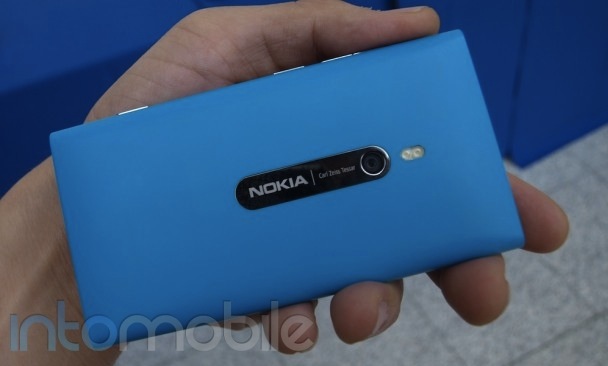
I’ve just spent the last few hours playing with the just-announced Nokia Lumia devices, the first phones from the handset maker that run the Windows Phone platform, and I really like the Lumia 800. It’s a shame that I won’t be able to buy one in the United States until at least 2012, if it ever comes at all. Will Nokia be too late to regain the dominance it once had in the United States?
Nokia used to rule the U.S. market with its feature phones but as smartphones emerged, Nokia couldn’t or wouldn’t catch up. The vast majority of U.S. cell phone purchases are through the carrier with subsidized devices and Nokia either wouldn’t play ball with these companies or couldn’t create products that were as compelling as some of the competition. With basically four major customers, the margin for error isn’t very large.
But with the Lumia 800 and to some extent, the 710, Nokia has products which are on par with nearly anything else out there on the market. The design is well thought out, the Windows Phone Mango platform is a delight to use and while I didn’t get too much time with the cameras, I’m sure that the Lumia line will provide some jaw-dropping photographs.
But that won’t matter at all this holiday season in the United States, as the only way to get these will be to have one imported and that’s too expensive of a proposition for the vast majority of users. Nokia is promising a “portfolio” of devices for the United States in 2012 but missing this holiday season will put it and Microsoft into an ever-deepening hole.
 It’s not like Nokia has horrible relationships with the U.S. carriers but if you were in the carriers’ positions, would you be bending over backwards to get the Lumia line? As compelling of a product that I think Windows Phone is, even Microsoft would admit that consumer demand is small and it’s not like U.S. smartphone buyers are going to be camping out for the next phone from Nokia.
There are also structural issues which may have made it hard for Nokia to get a Windows Phone on the major U.S. carriers before 2012. Every major Verizon Phone will support 4G LTE and that’s something Windows Phone just isn’t capable of yet. Sprint is still giddy from its launch of the iPhone 4S and 4 and I’d expect it to ride that into the holiday season. T-Mobile is actually promoting a Windows Phone but its porfolio leans heavily on Android, especially those that can support its HSPA+42 network. AT&T also seems to be doing just fine with the iPhone, even as the other carriers continue to pick it up.
Nokia says the Lumia 800 is a hero device that should be treated as such on most of the carriers that it is sold on. It’s a really nice phone but I think there could have been a lot of value in Nokia biting the bullet in the United States and getting it out in time for the holiday season, even if it doesn’t get the top billing with AT&T, Sprint, T-Mobile or Verizon. It could have exposed more and more smartphone buyers to this excellent hardware, would have been included in a ton of “must have smartphone” holiday guides and it would have brought some more recognition to Windows Phone.
Instead, we’ll have another record smartphone holiday buying season and tens of millions of users will get locked in to a contract and to a platform. The U.S. smartphone market isn’t going to stop growing in early 2012 by any means and I would expect Nokia to be a big part of Microsoft’s traditional CES keynote in January. Still, this could have been a major opportunity for Nokia to re-establish itself in an important market.
I know that I over-value the U.S. smartphone market at the expense of other countries simply because I live there and that the number of smartphone owners in China and Brazil will soon make the U.S. numbers seem like child’s play but the United States is still the top smartphone market and a thought leader in the mobile space. In this wildly competitive market, Nokia needs to be successful everywhere and it can’t win a fight if it doesn’t show up.