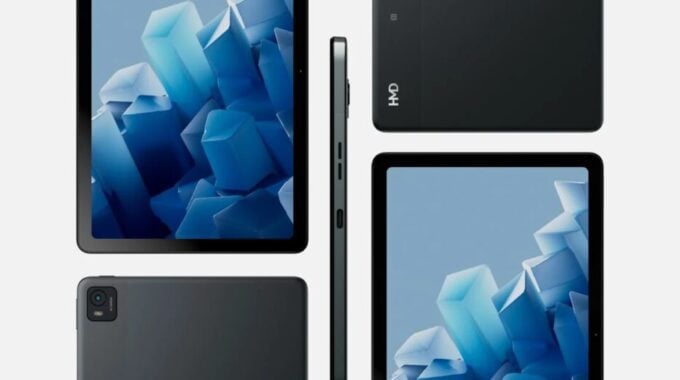
A kids’ tablet that can survive a drop, connect over 4G, and let parents actually control what their child sees online? That’s a harder combination to find than you’d think. HMD and Xplora are apparently taking a shot at it with the Go Pad, and based on what’s out there so far, this one is worth paying attention to.
According to Gizmochina, the Xplora Go Pad is built around an 8.7-inch IPS LCD screen. Resolution and refresh rate details haven’t been confirmed yet, so that’s a gap worth watching. Under the hood is the Qualcomm Snapdragon 685, a 6nm chip with four Cortex-A73 performance cores and four Cortex-A53 efficiency cores. It’s not going to run circles around flagship hardware, but for a kids’ learning device, it’s more than enough. It also includes a 4G modem, which means this thing can connect on its own without needing Wi-Fi. That’s a big deal for families who want kids to stay reachable outside the home.
Durability is clearly a priority. The Go Pad carries an IP65 rating for dust and water resistance and is said to handle drops from up to 100 cm. Any parent who has watched a child interact with a tablet knows how necessary that is. Charging tops out at 18W, though the battery size hasn’t been revealed yet. Memory and storage options are also still unknown.
The software side is where this tablet makes its clearest pitch. The Go Pad ships with a full set of parental tools, including:
- Web detection and harmful-content blocking
- Education-focused AI features
- Approved contacts management
- Social media and internet access controls
- Screen time limits
- Location tracking
That’s a pretty comprehensive toolkit. And it makes sense given where this device is coming from. HMD and Norwegian company Xplora previously teamed up on the Fusion X1 smartphone, which was built entirely around parental oversight. The Go Pad is the same philosophy applied to a larger screen. Tablets are just better suited for learning apps, video calls with family, and supervised media consumption, so the format upgrade feels like a natural next step.
The kids’ device market has been growing steadily, but a lot of products in this space either cut too many corners on hardware or slap on parental controls that are basic at best. What makes the Go Pad interesting is that it seems to be treating both the physical build and the software controls as equal priorities rather than one being an afterthought. The 4G connectivity is especially notable because it gives parents more flexibility around where and how kids use the device.
So far, neither HMD nor Xplora has officially said anything about pricing or availability. A full spec sheet is still missing too. But given how clearly this device is positioned, it won’t be a surprise if it lands somewhere in the mid-range family tech bracket. More details should come out as an official announcement gets closer. Keep this one on your radar.